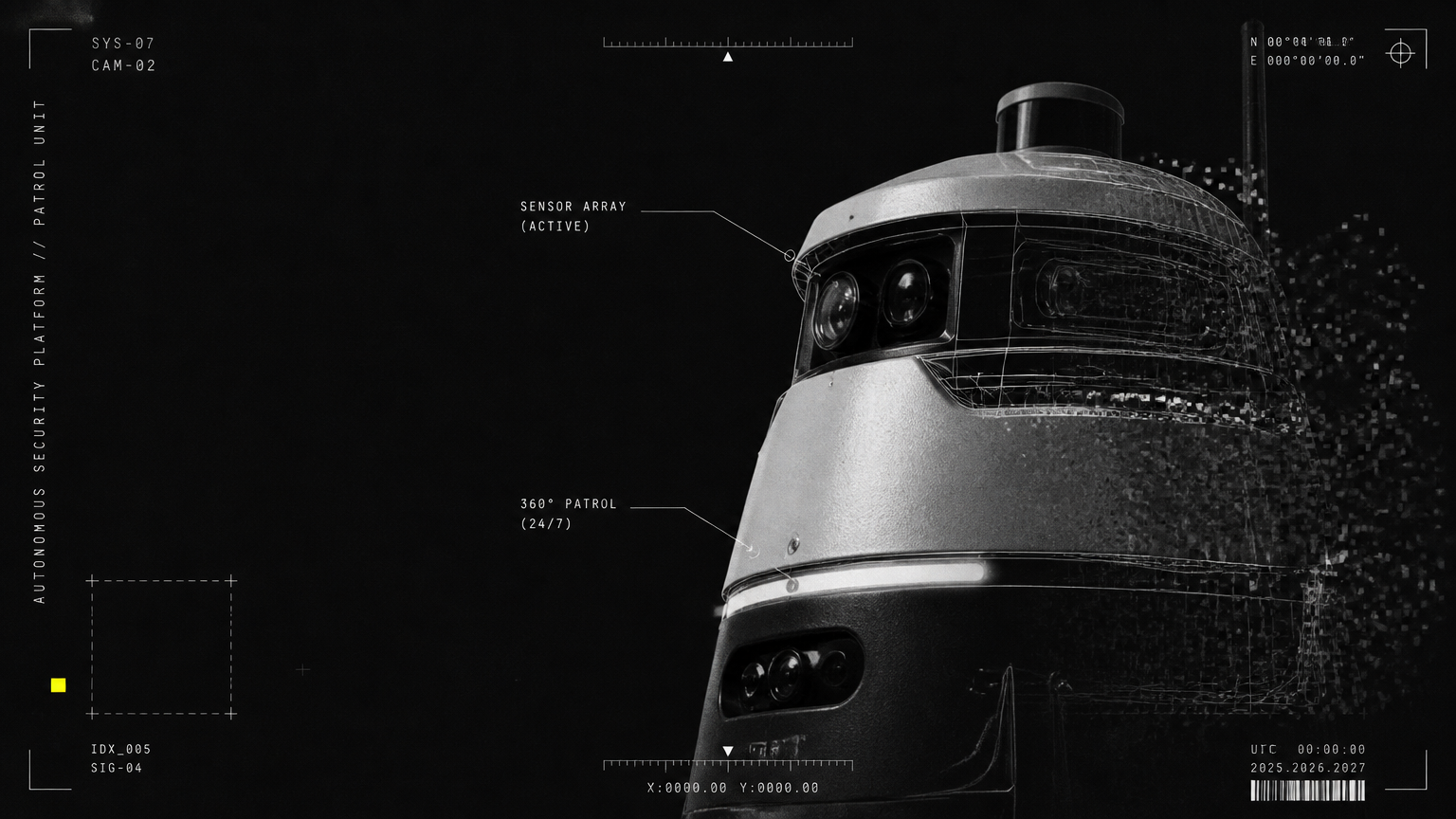
Quick answer: Your corporate campus needs an autonomous security robot if you face rising guard costs, gaps in night and weekend patrols, and inconsistent coverage across large, high-traffic buildings and parking areas. Autonomous security robots provide 24/7 patrolling, real-time monitoring and alerts, and consistent coverage to support lean facility and security teams.
If you manage an IT park, office park, or co-working campus, you already know the pressure. Foot traffic is dense during the day, parking lots and perimeters go quiet at night, and facility teams are expected to do more with leaner budgets. For many corporate facility heads and admin managers, manual guards plus CCTV was enough five years ago. Today, that combination leaves costly gaps.
This guide breaks down the five clearest signs that an autonomous security robot for corporate campus operations is no longer a nice-to-have, but an operational need. We will also explain how a security robot for office campus environments works alongside your existing team, what to evaluate, and how corporate campus security automation supports 24/7 reliability without adding headcount.
Sign 1: Guard and Front-Desk Costs Are Rising While Coverage Stays Flat — A Case for an Autonomous Security Robot
The first sign is financial. Front-desk staffing, lobby security, and roaming patrol guards represent one of the largest recurring facility costs for corporate campuses. Overtime for nights, weekends, and holidays adds up quickly, especially across multiple towers, gates, and parking blocks.
Yet higher spend rarely equals better coverage. One guard can only be in one place at a time. During shift changes, breaks, sick leave, or attrition — common in facility security roles — posts go thin. For IT campuses and office parks running 10-12 hour operations plus night shifts for global teams, you end up paying more to maintain minimum presence, not to improve vigilance.
An autonomous patrol robot for offices changes this equation by handling repetitive, route-based patrolling autonomously. It does not replace your guards. It extends them, covering long corridors, lobbies after hours, basements, and parking levels on consistent loops while your human team focuses on access decisions, escalations, and employee assistance.
Facility leaders evaluating corporate campus security automation typically look at:
What to audit this quarter
H3: Patrol cost per covered zone Map your total guard cost against actual patrolled square footage per shift. Most sprawling campuses discover they are paying for presence at gates and lobbies, while upper floors, stairwells, service corridors, and far parking zones receive only one or two checks per night.
H3: Overtime and attrition impact If overtime exceeds 15-20% of your security roster cost or you refill the same posts every few months, patrol consistency will suffer. Automation stabilizes the baseline so human staffing fluctuations do not create blind periods.
Allbotix approaches this challenge from an engineering-first perspective. With 525+ robots developed, 180+ happy clients, and proprietary AI fleet-management software built in-house rather than assembled from off-the-shelf parts, Allbotix designs patrol and surveillance support to lower the cost of consistent coverage while maintaining 99.8% uptime across deployments.
Sign 2: Night and Weekend Patrol Gaps Are Growing That an Autonomous Security Robot Can Close
The second sign is temporal: your campus is most vulnerable when it is least staffed.
Corporate campuses rarely sleep completely. Server rooms run, cleaning crews work, a few employees swipe in late, and delivery vehicles move through service gates. But after 8 p.m. and on weekends, most office parks drop to a skeleton guard team. A two-person team cannot simultaneously monitor the main gate, walk Tower A to Tower D, check the basement, and respond to a CCTV alert for the north parking lot.
This is where an IT campus surveillance robot and office park security robot add the most value. Programmed for 24/7 patrolling, autonomous systems run the same route with the same sensor attention at 2 a.m. as at 2 p.m. They stream video, flag anomalies, and trigger real-time alerts to your control room or facility manager's dashboard.
Where gaps usually appear
H3: Parking structures and perimeters Multi-level parking, visitor lots, EV charging bays, and compound walls are too large for infrequent foot patrols. Robots equipped with cameras, night vision, and two-way communication can loop these zones continuously and deter loitering or unauthorized access.
H3: Lobbies, atriums, and vacant floors After hours, lobbies and co-working floors sit empty but accessible to cleaning staff and late workers. Consistent robotic drive-throughs provide timestamped verification that these areas were checked, which manual logbooks often cannot prove.
Instead of adding a third night shift, many admin heads use autonomy to create continuous presence. Paired with Allbotix fleet-management monitoring, each patrol generates location-stamped data, video clips, and alert logs, giving facility teams real-time visibility without requiring someone to walk every corridor.
Sign 3: CCTV Gives You Footage, But Not Real-Time Response
CCTV is essential, but it is passive. Someone must watch the wall of monitors, notice the incident, and dispatch a guard. In practice, control rooms are understaffed, cameras go unmonitored for hours, and footage is reviewed only after an incident — a tailgating event at a turnstile, vandalism in a parking bay, or an unauthorized entry through a service door.
If your incident reports consistently say "identified on playback" rather than "intercepted during patrol," you have a response gap, not a camera gap.
Corporate campus security automation closes this loop by bringing sensing to the point of activity. An autonomous security robot on patrol acts as a mobile IoT checkpoint: it observes, analyzes, and escalates in the moment. When integrated with your existing VMS and access systems via fleet software, it can push alerts with location and video to guards who can then respond faster and with better context.
| Capability | Manual Guards Alone | Fixed CCTV Alone | Guards + Autonomous Patrol Robot Fleet |
|---|---|---|---|
| Coverage Model | Fixed posts + periodic rounds | Fixed camera views only | Fixed posts + continuous mobile patrols |
| After-Hours Presence | Limited by roster and overtime | Recording only, no intervention | 24/7 autonomous loops with alerts |
| Real-Time Detection | Depends on guard location | Depends on operator watching monitor | Onboard sensors + live streaming to control room |
| Evidence and Audit Trail | Handwritten logbooks | Playback footage to search manually | Timestamped patrol logs, video clips, and alert history |
| Scalability Across Towers and Parking | Requires more headcount per zone | Requires more cameras + cabling per zone | Add routes and robots via fleet-management software |
| Deterrence Effect | High at staffed gates, low in remote zones | Low without active monitoring | High visibility mobile deterrent with lights, audio, and cameras |
| Operational Insight for Facility Heads | Shift reports | Incident-only review | Central dashboard with patrol status and predictive maintenance |
This hybrid model is why office parks and co-working campuses adopt autonomy first for deterrence and verification, not for enforcement. The robot observes consistently and communicates instantly; humans decide and act.
Sign 4: Dense Foot Traffic and Multiple Entry Points Overwhelm Manual Checks
Daytime brings a different strain: volume. A single corporate campus can see thousands of employees, visitors, vendors, food delivery partners, and housekeeping staff moving through gates, lobbies, cafeterias, and business lounges. During peak hours — 8:30 to 10:30 a.m., lunch, and 5:30 to 7:30 p.m. — guards are pulled into crowd management, visitor verification, and vehicle queuing. Routine patrols stop.
Co-working campuses feel this even more acutely, with hot-desking members, day-pass users, and event attendees sharing the same access points.
A security robot for office campus use does not manage access control, but it relieves pressure around it by:
H3: Maintaining perimeter discipline during rush hours While your team handles gates and reception, the robot continues perimeter and parking patrols that would otherwise be paused.
H3: Providing visible reassurance in high-traffic zones Lobbies, atriums, and plaza areas benefit from a calm, visible patrol presence that signals monitoring without creating friction for employees and guests.
H3: Supporting safety audits and compliance For IT parks with client security audits, ISO requirements, or SEZ compliance needs, automated patrol logs provide consistent documentation of coverage frequency and incident response times.
Allbotix builds for these high-density realities. Its broader fleet spans AI receptionist robots, cleaning automation, serving and delivery robots, AMRs, cobots, and humanoids, all managed through the same proprietary fleet-management philosophy. For corporate clients, that means security patrolling can sit alongside front-desk automation and facility cleaning in one operational view, rather than as another isolated vendor system.
Sign 5: Incident Response Is Slow and You Lack a Single View of Campus Security
The final sign is operational: when something happens — a car alarm in B2, a door forced open on level 4, water leakage near a server corridor — how long does it take your team to verify, locate, and respond? If the answer depends on who is on duty and which radio channel is free, you lack real-time operational visibility.
Modern facility teams need three things: live location of patrol assets, instant alerts with context, and a record of what was checked and when. Manual systems rarely deliver all three.
An autonomous security robot designed for corporate use streams its position, sensor status, and live video to a central dashboard. Facility heads can see which zones were covered, reroute patrols during an event or VIP visit, and review alert-tagged clips instead of scrubbing hours of footage. Predictive maintenance in the fleet software also flags battery, sensor, or navigation health before it causes downtime — a key reason Allbotix maintains 99.8% uptime across its deployments.
How an Autonomous Security Robot Fits Into Corporate Campus Operations
Understanding fit is critical. Autonomous patrol is not a guard replacement project. It is a force multiplier for lean teams.
H3: Working alongside human guards The most effective model is collaborative. Guards retain authority for access, confrontation, and emergency decisions. Robots handle dull, dirty, and dangerous repetition: long night loops, parking heat checks, perimeter verification, and lobby drive-throughs. Two-way audio lets a remote guard speak through the robot to deter trespassers or guide a lost visitor without walking across campus.
H3: Fleet-management monitoring for admin teams Allbotix pairs hardware fleets with proprietary AI fleet management featuring real-time monitoring and predictive maintenance. Admin managers get a single pane for patrol status, alerts, and robot health, whether overseeing one tower or a multi-building IT park. Because the stack — design, firmware, source code — is engineered in-house with full IP ownership, routes, escalation rules, and reporting can be tailored to a client's specific precision, ambition, and scale.
H3: 24/7 support for office parks and co-working campuses Corporate operations cannot pause for robot downtime. Look for 24/7 Premium Support, Made-in-India manufacturing depth for spares, and a deployment partner with cross-industry experience. Allbotix, backed by publicly listed Nanta Tech Limited and scaled via its Aimtron Technologies manufacturing partnership, brings that enterprise-grade backing to facility robotics, guided by its principles of limitless innovation and precision engineering.
What to Evaluate Before You Deploy Corporate Campus Security Automation
If you recognized two or more of the signs above, run a structured pilot evaluation rather than a campus-wide rollout.
Start with a coverage audit. Identify your highest-risk, lowest-coverage zones: typically parking basements, rear perimeters, service entries, and vacant floors. Define success metrics in advance — patrol frequency per zone, alert response time, overtime reduction, and audit documentation completeness.
Then evaluate vendors on engineering substance, not brochures. Ask who owns the IP, how fleet software handles multi-robot coordination, what happens during network drops, how night navigation handles low light and reflective floors, and what support SLAs back nighttime operations. For corporate campuses, dense foot traffic reliability, elevator and access integration readiness, and data security practices matter as much as camera specs.
Finally, plan change management. Brief guards that robots reduce walking load and improve safety, not headcount. Brief employees that patrol robots improve after-hours safety and provide faster assistance. A short pilot in one tower and one parking block, with weekly review of patrol logs and alerts, builds confidence quickly.
Your campus does not need more cameras to watch later or more overtime to cover less. It needs consistent, verifiable, 24/7 presence that supports the team you already have. That is exactly what an autonomous security robot for corporate campus environments delivers: continuous patrolling, real-time monitoring and alerts, and auditable coverage across buildings and parking areas.
Bring Precision-Engineered Patrol to Your Campus with Allbotix
If rising costs, night-shift gaps, blind spots, and slow response sound familiar, it is time to walk your campus with Allbotix. Our team will assess your towers, lobbies, parking, and perimeter, design autonomous patrol routes for your risk profile, and show how fleet-managed robots work alongside your guards from day one.
Talk to Allbotix today to schedule a campus security automation assessment and pilot an autonomous security robot built for corporate scale, reliability, and 24/7 peace of mind.