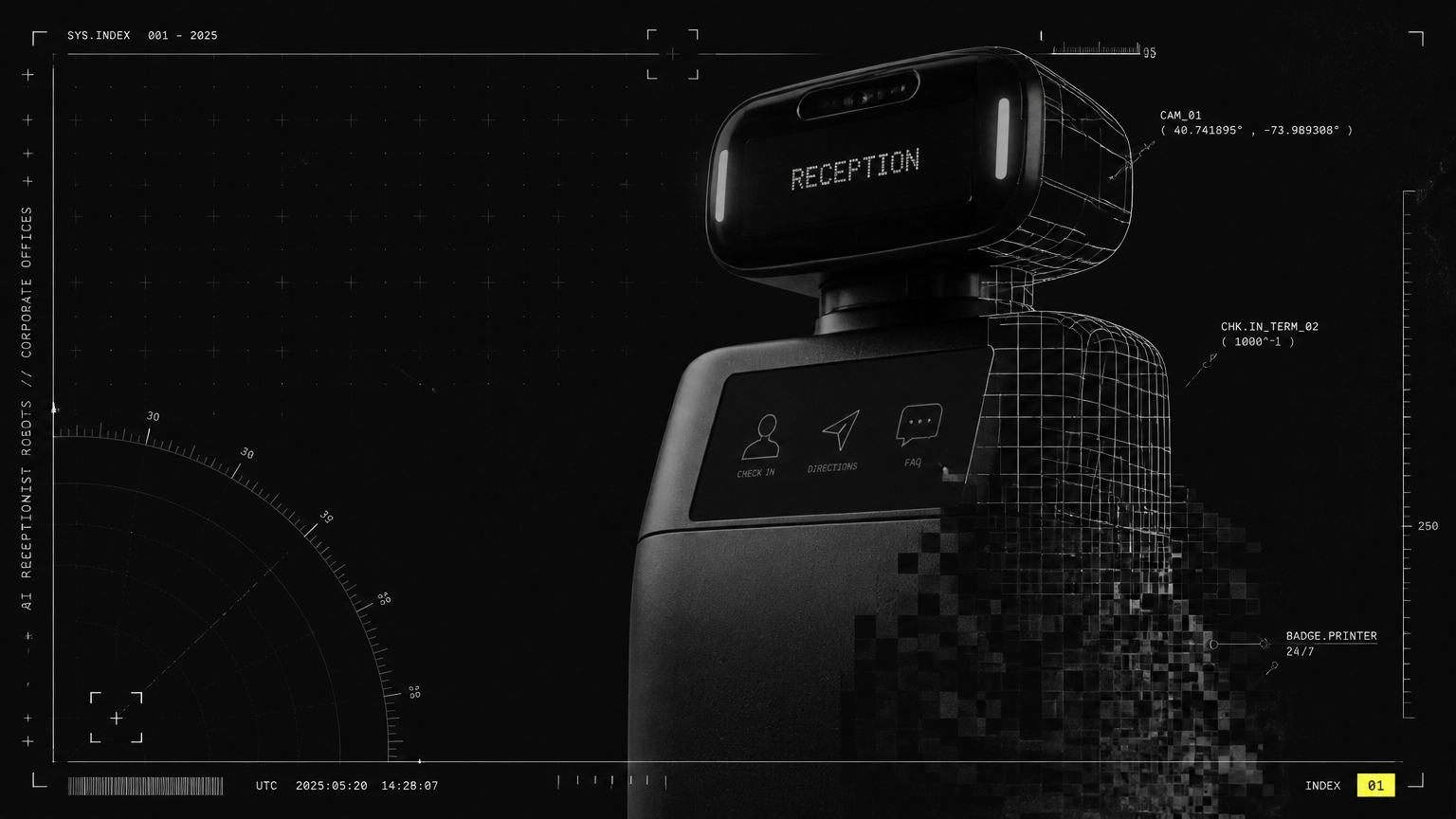
Quick answer: AI receptionist for government offices reduces wait times at scale by automating check-in, queue and token management, document guidance, and multilingual wayfinding 24/7. For agencies with tight staffing budgets, Allbotix AI receptionist robots deliver consistent, transparent front-desk service while freeing staff for complex citizen needs.
Citizen footfall in public offices is dense, unpredictable, and highly time-sensitive. From municipal corporations and citizen service centers to licensing departments, tax offices, and transit-linked public buildings, a single understaffed front desk can create hours-long queues. An AI receptionist robot for government offices is designed for exactly this environment: high-volume, multilingual, document-heavy interactions that need to be handled quickly, consistently, and transparently.
How an AI Receptionist for Government Offices Cuts Wait Times at Scale
An AI receptionist for government offices does not just greet visitors. It functions as an automated visitor management system for government facilities, orchestrating the entire arrival-to-service journey so queues keep moving even during peak hours.
1. Automated check-in and token management
Manual registers and single-window enquiries are the biggest bottleneck in public offices. An AI front desk for public sector offices automates this first mile:
- Self check-in with purpose-of-visit selection, ID capture, and photo verification
- Automatic token generation linked to a government office queue management system
- Real-time queue status on screen and via SMS/display boards, with estimated wait times
- Priority routing for seniors, persons with disabilities, and appointment holders
- No-show and re-call handling so counters do not sit idle
By parallelizing check-in — one robot can handle continuous arrivals while staff focus on casework — agencies can reduce wait times in government offices without adding headcount at the reception.
2. Instant answers to high-frequency citizen FAQs
A large share of wait time comes from citizens queuing simply to ask: Where do I go for this? What documents do I need? Is this counter open today?
AI receptionists are trained on office-specific FAQs: timings, holidays, counter locations, eligibility criteria, fees, and escalation paths. Citizens get immediate, consistent answers at the entrance instead of waiting in the wrong line for 40 minutes. This deflection alone can reduce load on enquiry counters by a significant margin during morning rush and post-lunch peaks.
3. Form and document guidance before citizens reach the counter
Incomplete applications are a hidden driver of delays. When citizens reach the counter missing an ID proof, photograph, or attestation, service time doubles and the queue stalls.
An AI receptionist provides step-by-step guidance on forms, checklists of required documents, and sample formats. It can verify that visitors have the right papers before issuing a token for a specific service, and direct those with incomplete files to help desks, photocopy stations, or online portals first. The result is faster counter transactions and fewer repeat visits.
4. Wayfinding across complex public buildings
Government complexes are often sprawling, with multiple blocks, floors, and wings. Visitors wandering between Block A and Block C add congestion and staff interruptions.
AI receptionist robots provide interactive wayfinding with maps, directions in local languages, and escort coordination where needed. For large citizen service centers and transit-linked public buildings, this keeps circulation smooth and prevents lobby crowding.
5. Multilingual support for inclusive access
India’s public offices serve citizens across languages, literacy levels, and digital comfort. Voice-first interaction in multiple languages, large touch interfaces, and simple visual flows make the AI kiosk for citizen services accessible to first-time visitors, elderly citizens, and those uncomfortable with mobile apps or English-only signage.
This is critical at scale: when every citizen can self-serve in their preferred language, throughput increases without additional interpreters or volunteers at the gate.
Why an AI Receptionist for Government Offices Fits Public-Sector Constraints
Government facility managers operate under constraints that private offices rarely face: fixed staffing budgets, 24/7 service expectations for certain facilities, and an obligation to provide consistent, transparent service to every citizen.
Designed for tight staffing budgets
Hiring, training, and retaining front-desk staff for multiple shifts across multiple locations is costly and often unfeasible. Contract staff turnover creates inconsistency in how citizens are greeted, queued, and guided.
Allbotix approaches this as an engineering challenge. Allbotix engineers and deploys AI receptionist robots paired with proprietary AI fleet-management software, built in-house rather than assembled from off-the-shelf parts. With 525+ robots developed and 180+ happy clients across service and industrial environments, the platform is built to add front-desk capacity without linear growth in staffing cost. Staff are then redeployed to verification, grievance redressal, and complex cases where human judgment matters most.
Consistent, transparent public-facing service
Public service demands auditability. Who was served, in what order, with what wait time, and with what outcome?
An automated visitor management system for government creates a digital log of check-ins, tokens, queue movements, and service handoffs. Displayed token numbers and announced wait times make queue discipline visible and fair, reducing disputes over preferential treatment. For administrators, dashboards show peak hours, counter-wise load, average handling time, and abandonment — data that supports transparent reporting and better roster planning.
24/7 availability with engineered reliability
Citizen service centers, transport hubs, hospitals in government campuses, and emergency-linked offices see footfall beyond 9-to-5. An AI receptionist robot for government offices provides round-the-clock greeting, information, and wayfinding, even when counters are closed.
Reliability at scale requires more than hardware. Allbotix combines its robot fleets with proprietary fleet-management and predictive-maintenance software for real-time monitoring, backed by 24/7 Premium Support and 99.8% uptime. The company’s in-house engineering — full IP ownership of design, firmware, and source code — and Made-in-India manufacturing scaled via its Aimtron Technologies partnership support long-term serviceability for public infrastructure.
Deploying an AI Receptionist for Government Offices at Scale: What It Takes
Reducing queues in one lobby is a pilot. Reducing wait times across a district or department is a system deployment. For public-sector decision-makers, three elements determine success at scale.
Integration with visitor management workflows
A standalone kiosk that prints tokens but does not talk to counters creates a new silo. Effective deployment integrates check-in, queue logic, counter allocation, and display systems into one flow:
- Token categories mapped to departments, services, and floors
- Counter-side dashboards for calling next, recall, transfer, and break management
- Integration with appointment systems, access control, and visitor passes where required
- Reports for daily footfall, service-level adherence, and staff productivity
Allbotix designs its AI receptionists as part of a connected front-desk workflow, not as isolated devices, so municipal offices can standardize the citizen journey across locations.
Fleet management, uptime, and support
A single robot going offline during a Monday rush can recreate the very queue it was meant to eliminate. At scale, centralized visibility is non-negotiable.
Key requirements include remote health monitoring, battery and connectivity alerts, software updates without site visits, and rapid on-ground support. Allbotix’s proprietary AI fleet-management software provides real-time monitoring and predictive maintenance across its diverse fleet spanning receptionist, cleaning, serving, AMR, cobot, and humanoid form factors. Backing from publicly listed Nanta Tech Limited adds institutional credibility for long-cycle public procurement and multi-year operations.
Choosing the right front-desk model for high-volume public buildings
Public offices typically evaluate three approaches for citizen intake. The right choice depends on footfall density, multilingual needs, and transparency requirements.
| Criterion | Traditional Staffed Counter | Static Touchscreen Kiosk | Allbotix AI Receptionist Robot |
|---|---|---|---|
| Check-in and tokening | Manual register, single queue, limited throughput | Self-service token printing, fixed menu flow | Conversational check-in with purpose detection and automatic token routing |
| Government office queue management system | Paper tokens or verbal calls, low visibility | Basic numbering, limited counter integration | Integrated queue logic with counter dashboards, displays, and analytics |
| Multilingual and voice support | Depends on staff availability | Typically touch-only, 1-2 languages | Voice-first multilingual interaction with large-format touch and visuals |
| Wayfinding and FAQs | Staff interruptions for directions | Static maps and fixed FAQ screens | Interactive wayfinding, dynamic FAQs, and document guidance |
| Uptime and multi-site management | Shift-dependent, turnover risk | Per-device maintenance, no fleet view | Centralized fleet management, predictive maintenance, 24/7 Premium Support |
| Transparency and reporting | Manual logs, difficult to audit | Limited logs, device-level data | Digital audit trail of visits, tokens, wait times, and service handoffs |
| Best fit | Low-footfall single offices | Single-service lobbies with simple flows | Municipal offices, citizen service centers, transit-linked public buildings |
Where AI Front Desks Deliver the Most Impact in the Public Sector
Municipal offices and ward service centers
Property tax, water, birth and death certificates, and trade licenses drive repetitive, seasonal surges. An AI receptionist robot for government offices absorbs the surge with parallel check-ins, document checklists, and counter routing, keeping lobbies orderly during collection deadlines and special camps.
Citizen service centers and single-window complexes
These centers promise multiple services under one roof but often struggle with cross-department navigation. An AI front desk for public sector offices acts as a triage layer: understanding citizen intent, issuing the correct department token, and guiding visitors floor-by-floor. This prevents the common failure where citizens queue at the wrong department and restart the process.
Transit-linked public buildings and high-density campuses
Railway-linked administrative blocks, bus-terminal service points, and large government campuses face continuous, high-churn footfall similar to airports and transit hubs. Here, the combination of 24/7 availability, multilingual voice interaction, and real-time queue displays keeps throughput high without expanding lobby staff.
The same platform logic also serves adjacent public infrastructure — education campuses needing visitor management, healthcare facilities managing outpatient queues, and corporate parks managing dense entry traffic — which helps standardize operations for agencies managing mixed-use premises.
Measuring Success: How to Reduce Wait Times in Government Offices and Prove It
For public-sector leaders, the business case must be measurable and citizen-visible. A well-scoped deployment tracks:
- Average wait time and queue length by hour, counter, and service type
- Check-in throughput during peak windows (arrivals processed per hour)
- First-time-right rate: share of citizens reaching counters with complete documents
- Wrong-queue rate: reduction in transfers between counters
- Citizen feedback scores on clarity, fairness, and ease of navigation
- Staff hours redeployed from repetitive enquiry to case resolution
Because the system logs every token and handoff, facility managers can compare pre- and post-deployment baselines, adjust counter rosters to actual demand curves, and publish service improvements with data. Precision engineering in both hardware and software makes these metrics repeatable across sites, supporting the brand promise of limitless innovation applied to everyday citizen experience.
Deployment typically starts with one high-footfall lobby — mapping services, FAQs in required languages, token categories, and display layouts — then replicates the template across other offices. In-house engineering allows the interaction flows, languages, and integrations to be tailored to each department’s specific scale and precision needs rather than forcing a generic kiosk template.
Bring Consistent, Scalable Service to Every Citizen Touchpoint
Queues are not just an inconvenience. In government offices, long waits erode trust, waste citizen workdays, and overload frontline staff. An AI receptionist for government offices provides a practical path to reduce wait times in government offices at scale: automated check-in, disciplined queue management, proactive document guidance, and inclusive multilingual wayfinding, all delivered with the consistency public service demands.
Allbotix helps government and public-service teams deploy AI receptionist robots with integrated visitor management, fleet-wide monitoring, and dependable support for high-density environments.
Talk to Allbotix to design an AI front desk for your citizen service network — visit https://www.allbotix.ai/ to schedule a demo and scope a pilot for your highest-footfall office.