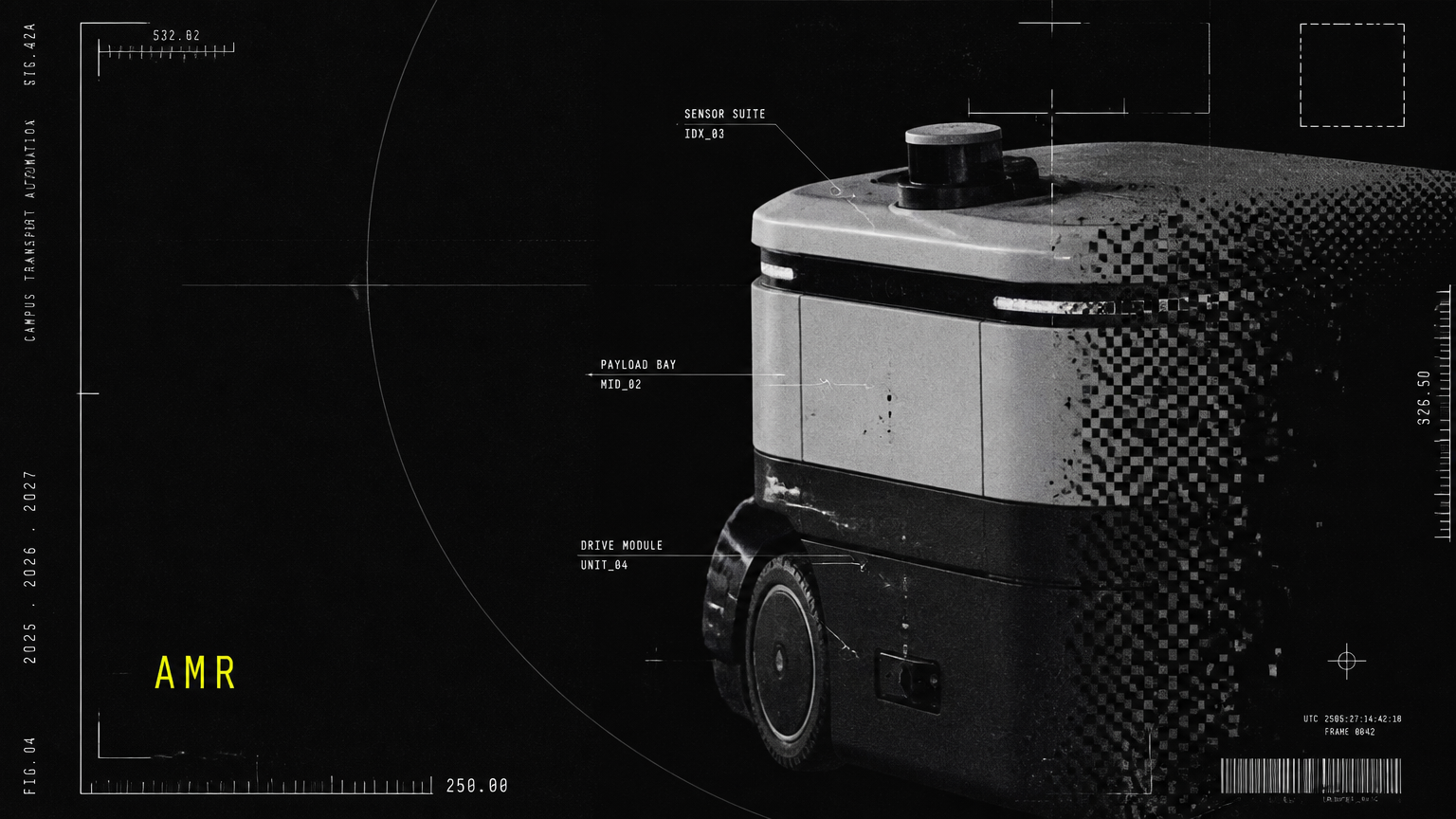
Quick Answer: Autonomous mobile robots for university campus automate transport across large university grounds by moving mail, lab supplies, library materials and facility goods between buildings without manual staff effort. With autonomous navigation and centralized fleet management, they reduce support-staff load, improve campus safety, and keep sprawling operations running efficiently.
For university administrators and facility managers, the logistics challenge is familiar: a campus that spans hundreds of acres, dozens of buildings, and thousands of daily material movements — all supported by a thin team of support staff. From inter-department mail to time-sensitive lab samples, the constant shuttling of goods drains productivity, increases costs, and pulls skilled staff away from higher-value work. This is where university campus transport automation is changing the operating model.
Instead of relying on manual carts, vans, and ad-hoc student runners, forward-looking institutions are deploying campus delivery robots to create scheduled, traceable, and safe material flow across indoor and outdoor environments.
Why Sprawling Campuses Need University Campus Transport Automation
Large university grounds were not designed for efficient logistics. Academic blocks, research labs, libraries, hostels, administrative offices, and maintenance depots are often spread over 100 to 1,000+ acres. A single delivery of documents or lab kits can mean a 20-30 minute round trip on foot or by cart.
Three structural pressures make this unsustainable:
1. Sprawling distances: Staff spend hours daily walking or driving between buildings for low-value transport tasks. During peak periods — admissions, exams, research deadlines, events — demand spikes beyond what the team can handle.
2. Thin support staff: Education institutions operate with tight facilities budgets. Hiring additional runners, drivers, and mailroom staff for transport alone is rarely justifiable, and turnover in these roles is high.
3. Safety and security risks: Manual transport after hours, movement of sensitive documents, biological samples, or high-value equipment across open grounds creates risk. Untracked handoffs, lost items, and lack of chain-of-custody are persistent concerns for operations leaders.
University logistics robots address all three by providing a reliable, always-available transport layer that works alongside existing staff rather than replacing them.
High-Impact Use Cases for Campus Delivery Robots
AMR material transport in education is not about one single task. The highest ROI comes from consolidating multiple repetitive flows onto one autonomous fleet.
1. Autonomous Mail Delivery on Campus and Inter-Department Documents
Mailrooms remain the heartbeat of campus administration. Autonomous mail delivery on campus connects the central mailroom to faculties, admissions, finance, HR, and registrar offices on fixed schedules.
An AMR can run morning and afternoon loops, stop at designated indoor stations, authenticate pickup via PIN or RFID, and return with outbound mail. Every handoff is logged, eliminating lost parcels and providing full traceability for confidential documents, exam papers, and contracts.
For administrators, this means fewer missed SLAs, no need for dedicated mail runners, and a professional, predictable service for every department.
2. Lab Samples, Research Kits, and Medical Transfers
Research universities move hundreds of sensitive items daily: pathology samples between labs and campus clinics, chemistry reagents, engineering prototypes, and field-research kits.
AMRs equipped with lockable, temperature-stable compartments maintain chain-of-custody and reduce contamination risk compared to open carts. Scheduled runs ensure samples arrive within required time windows, while fleet software records who loaded, transported, and received each payload.
This is especially valuable for institutions with medical schools, biotech parks, or distributed science blocks where timing and integrity are critical.
3. Library Books and Learning Materials
Inter-library transfers, book returns, and bulk movement of study materials between central and departmental libraries are ideal for automation. Library staff currently push heavy trolleys across long corridors and courtyards — work that is physically demanding and time-consuming.
Campus delivery robots with shelved payload modules can carry 50-100 kg of books per trip, operate quietly inside library halls, and navigate elevators and automatic doors. Returns are faster, staff injuries decline, and librarians can focus on student services rather than logistics.
4. Facility Supplies, Maintenance Tools, and Hospitality Goods
Facility management teams constantly move cleaning consumables, spare parts, tools, pantry supplies, and event materials. These loads are bulky, repetitive, and often needed urgently across hostels, cafeterias, auditoriums, and sports complexes.
AMRs handle these facility goods on-demand via a simple dispatch app. A technician in Block C can request parts from the central store, and a robot delivers them without pulling another technician off-task. During events and conferences, the same fleet supports catering and linen movement.
How Autonomous Mobile Robots for University Campus Solve Staffing, Distance, and Safety Pain Points
Unlike fixed conveyors or manual processes, modern AMRs combine autonomous navigation, obstacle avoidance, and fleet intelligence to operate reliably in dynamic campus life.
Reducing support-staff load: One AMR fleet can absorb 60-80% of repetitive point-to-point trips. Staff no longer walk kilometers per day for deliveries. Instead, they load and unload at their building, while the robot does the transit. This extends the capacity of existing teams without new hires — critical when budgets are constrained.
Taming sprawling operations: AMRs run consistent, scheduled routes 12-20 hours a day, regardless of weather shifts, class changes, or staff availability. Central operations get predictable delivery windows and real-time visibility into every trip, from dispatch to delivery confirmation.
Improving campus safety: Built for pedestrian environments, university-grade AMRs use 3D LiDAR, depth cameras, and ultrasonic sensors for 360-degree perception. They slow down in crowds, stop for pedestrians, navigate speed-breakers and ramps, and operate with lights and audio alerts. Lockable compartments and user authentication protect sensitive payloads, while night-time runs reduce the need for staff to cross isolated grounds after dark.
Deployment Essentials: What Makes Outdoor Autonomous Mobile Robots Campus-Ready
Not all mobile robots are built for universities. A warehouse AMR that works on flat epoxy floors will fail on a campus with pathways, curbs, rain, dust, and student foot traffic. Deployment success depends on three essentials.
1. True Indoor-Outdoor Navigation
Outdoor autonomous mobile robots campus deployments must transition seamlessly from polished indoor lobbies to outdoor pathways, ramps, and service roads.
Look for:
- Multi-sensor fusion (LiDAR + visual SLAM + GPS/RTK) for reliable localization with and without satellite coverage
- Ability to handle inclines, uneven pavers, expansion joints, and wet surfaces
- IP-rated weather protection for dust, light rain, and heat
- Elevator and automatic-door integration for multi-floor buildings
- Dynamic re-routing around construction zones, parked vehicles, and event crowds
Precision mapping of the campus — including no-go zones, pedestrian-only hours, and priority lanes — ensures the fleet respects campus rules from day one.
2. Safe Operation in Dense Student Foot Traffic
Safety is the top concern for university leaders evaluating university logistics robots. A campus-ready platform should include:
- 360-degree obstacle detection with predictive pedestrian behavior
- Adjustable speed zones: crawl speed in plazas and canteens, higher speed on service roads
- Emergency stop, remote stop, and obstacle creep-and-wait behavior
- LED indicators, turn signals, and polite audio prompts
- Compliance with institutional safety reviews and risk assessments
The goal is co-existence, not segregation. Students should barely notice the robots — except that deliveries arrive on time.
3. Fleet Management and Campus System Integration
Single robots create pilots. Fleets create transformation. Centralized AI fleet-management software is what turns 3-5 AMRs into a campus transport network.
Key capabilities include centralized dispatch, multi-robot traffic management at narrow corridors and intersections, scheduled loops plus on-demand requests, live tracking dashboards, delivery proofs, and predictive maintenance alerts to sustain high uptime.
Integration with existing systems — mailroom ticketing, facility helpdesks, building access control, and elevator controllers — allows staff to request a robot from tools they already use, without new complexity.
Manual Transport vs. AGVs vs. AMRs: What Fits a University?
University operations leaders often ask whether to continue with manual methods, install fixed-path AGVs, or invest in AMRs. The differences matter significantly on a dynamic campus.
| Criteria | Manual Staff & Carts | Fixed-Path AGVs | Autonomous Mobile Robots (AMRs) |
|---|---|---|---|
| Navigation | Human-driven, variable routes | Magnetic tape / QR codes, fixed lines | Autonomous SLAM + GPS, dynamic routing |
| Indoor-Outdoor Capability | Yes, but labor-intensive | Indoor only, fails outdoors | Designed for indoor-outdoor transitions |
| Adaptability to Changes | Flexible but inconsistent | Requires re-installation for route changes | Software remapping in hours, no infrastructure |
| Safety in Crowds | Depends on operator | Stops on fixed path, limited perception | 360-degree perception, crowd-aware slowdown |
| Traceability & Reporting | Paper logs, no visibility | Basic PLC logs | Fleet dashboard, proof-of-delivery, audit trail |
| Scalability | Linear hiring needed | High civil cost to scale | Add robots and zones via software |
| Operating Hours | Shift-limited | Shift-limited | 12-20 hours, night runs possible |
| Total Cost Over 3 Years | Rising labor + injury costs | Infrastructure + maintenance | Lower per-trip cost, high fleet utilization |
For sprawling, people-dense, ever-changing university grounds, AMRs offer the only practical path to scalable university campus transport automation without civil work or constant supervision.
Reliability, Cost-Effectiveness, and Uptime
Campus leaders rightly ask: will they work every day, and will they pay back?
Reliability comes from engineering and support, not just autonomy demos. Look for vendors with in-house design ownership across mechanics, electronics, and firmware, Made-in-India manufacturing for faster spares, and 24/7 monitoring with predictive maintenance. Well-managed AMR fleets in service and industrial environments routinely target 99%+ uptime because issues are detected before they cause downtime.
On cost-effectiveness, the math is straightforward. A single AMR running scheduled loops can replace hundreds of staff walking-hours per month. When one fleet consolidates mail, library, lab, and facility flows, utilization stays high and cost-per-trip falls sharply. Institutions also avoid overtime during peaks, reduce vehicle fuel and maintenance for intra-campus vans, and cut losses from misplaced or delayed materials.
Just as important is consistency. Deliveries happen on schedule during exams, monsoons, staff leave, or late-night research runs — keeping academic and administrative operations running efficiently.
How Allbotix Approaches Autonomous Mobile Robots for University Campus
Allbotix engineers and deploys Autonomous Mobile Robots as part of a broad, multi-vertical fleet that also spans AI receptionists, cleaning, serving, cobots, and humanoids — all paired with proprietary AI fleet-management software for real-time monitoring and predictive maintenance.
For education campuses, that breadth matters. A university does not need a single-use robot; it needs a transport partner that can start with autonomous mail delivery on campus, then expand the same fleet platform to library logistics, lab transfers, and facility supply runs. Because Allbotix systems are engineered in-house — with full IP ownership of design, firmware, and software rather than assembled from off-the-shelf parts — payloads, access control, and navigation behaviors can be tailored to a client's specific precision, ambition, and scale.
With 525+ robots developed, 180+ happy clients, and 99.8% uptime backed by 24/7 Premium Support, plus manufacturing scale through its Aimtron Technologies partnership and backing from publicly listed Nanta Tech Limited, Allbotix brings precision engineering and limitless innovation to long-term campus deployments — not just pilot projects.
Getting Started: A Practical Path for Campus Operations Leaders
You do not need to automate the entire campus on day one. High-performing institutions follow a phased approach:
- Map high-frequency flows: Audit daily trips between mailroom, admin blocks, labs, and library. Prioritize repetitive, time-consuming routes.
- Pilot one loop: Start with 1-2 AMRs on a defined indoor-outdoor mail and parcel loop with clear KPIs — on-time rate, staff hours saved, and incident-free kilometers.
- Expand use cases: Add library, lab, and facility payload modules and on-demand dispatch once the core loop is stable.
- Scale to a fleet network: Connect multiple buildings, integrate elevators and access control, and manage everything from a central fleet dashboard.
With the right partner, a pilot can go live in weeks, with campus mapping, safety validation, and staff training handled end-to-end.
Large university grounds will only get busier, more distributed, and more service-intensive. Autonomous mobile robots for university campus give administrators a safe, reliable, and cost-effective way to keep materials moving — without overloading thin support teams.
Ready to automate transport across your campus? Talk to Allbotix at https://www.allbotix.ai/ to design an AMR pilot for mail, lab, library, and facility logistics — engineered for your grounds, integrated with your workflows, and supported 24/7.