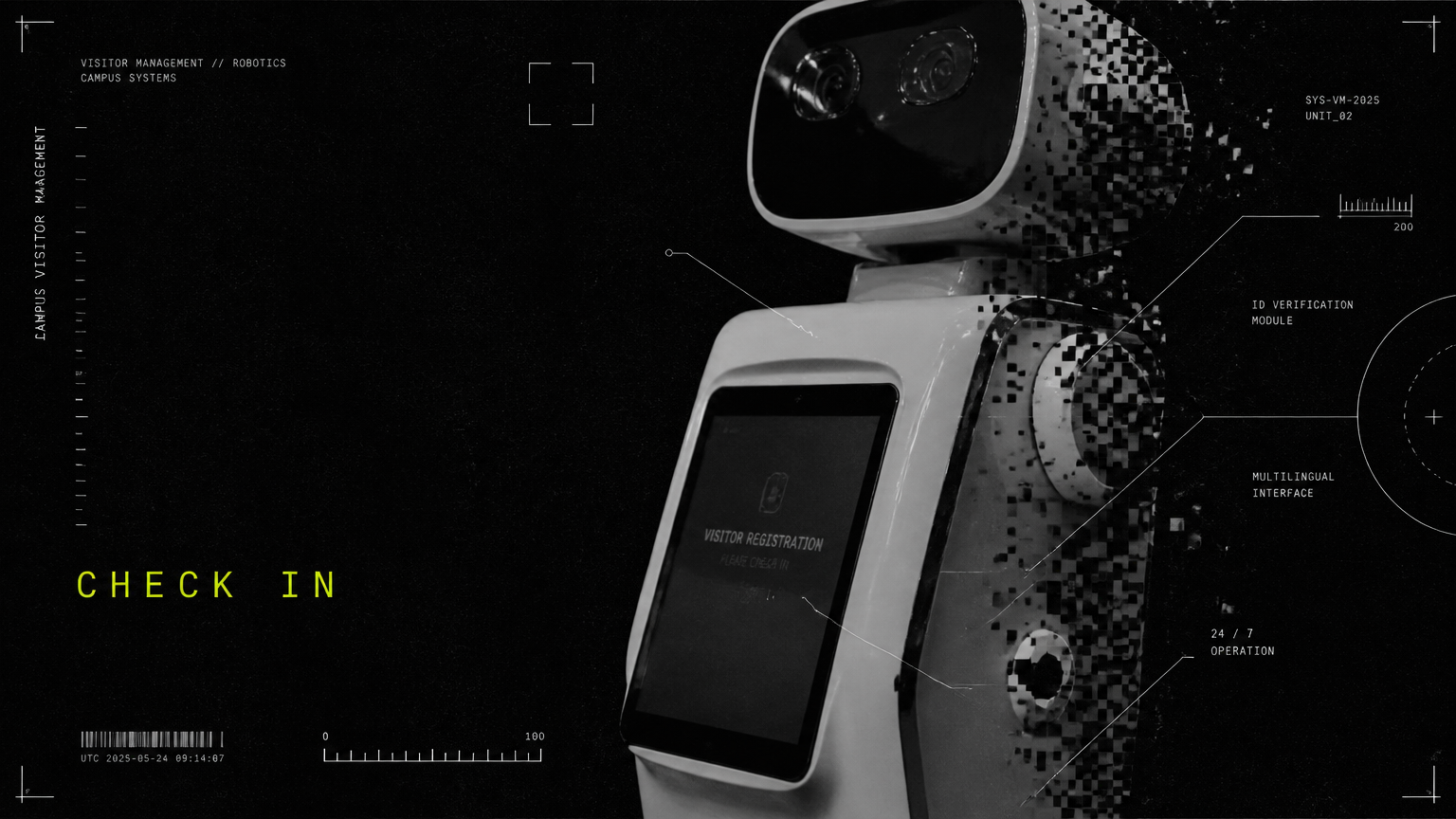
Universities are turning to robotics for campus visitor management to automate check-ins, strengthen security, and manage high visitor volumes with thin support staff. AI receptionist robots deliver 24/7 multilingual registration, ID verification, and wayfinding while freeing staff for higher-value student services.
A modern campus visitor management system is no longer a paper logbook at the gate. For universities handling thousands of daily movements — prospective students and parents, vendors, contractors, guest lecturers, alumni, and event attendees — automation has become operational necessity, not futuristic luxury.
What a Modern Campus Visitor Management System Includes
A university visitor management system today is a connected layer of software, hardware, and security workflows. At its core, it answers three questions in real time: who is on campus, why are they here, and where are they authorized to go?
Unlike a standalone sign-in app, a complete system for higher education typically combines:
Automated visitor check-in for universities: Self-service registration with ID scan, photo capture, purpose of visit, host selection, and automatic badge printing. Pre-registration links allow admissions visitors or conference guests to complete details before arrival, cutting lobby queues during peak periods.
Campus access control and visitor tracking: Every check-in creates a time-stamped digital record tied to ID verification, building access permissions, and check-out. Security teams get a live dashboard of visitor presence by building, gate, and department, with instant audit trails for compliance reviews and incident investigations.
Department handoffs and notifications: When a visitor arrives for admissions, HR, examinations, or facilities, the system automatically notifies the host via SMS, email, or dashboard alert, confirms escort requirements, and logs handoff time. No phone tag at the front desk.
Wayfinding and campus navigation support: On large, multi-building campuses, check-in is only half the journey. Modern systems integrate maps, directions, and escort coordination to get a first-time visitor from Gate 1 to the Department of Physics without getting lost.
For a visitor management system for colleges operating across dispersed blocks, hostels, libraries, labs, and auditoriums, this connectivity is what separates a true platform from a tablet on a stand.
Beyond the Paper Logbook
Paper registers and Excel sheets cannot meet current expectations for safety, speed, or accountability. They are illegible, easily falsified, impossible to search in an emergency, and offer no verification that the person signing in is who they claim to be.
Digital systems solve the record-keeping problem. Robotic systems solve the staffing and experience problem on top of it.
Why a Robotic Campus Visitor Management System Outperforms Manual Front Desks
University front desk automation is accelerating for a simple reason: visitor expectations have risen while administrative staffing has not. Admissions season, orientation week, placement drives, convocations, seminars, and competitive exams can triple footfall overnight. Hiring temporary front-desk staff for every spike is expensive and inconsistent.
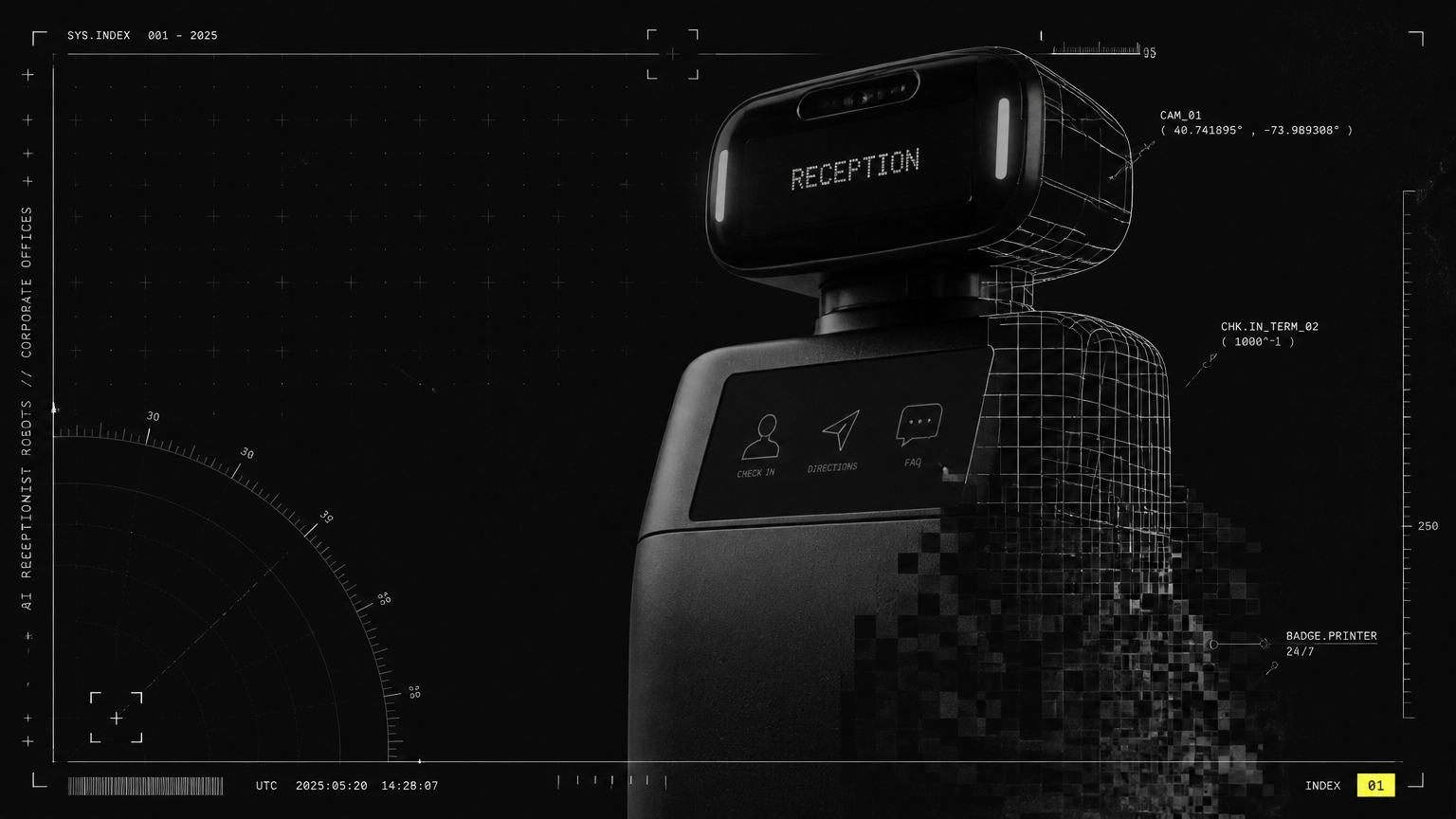
An AI receptionist robot for universities acts as a tireless first point of contact — greeting in multiple languages, guiding registration step-by-step, verifying ID, printing badges, and calling hosts — without adding headcount.
| Capability | Manual Front Desk & Paper Log | Tablet / Kiosk Check-In App | AI Receptionist Robot for Universities |
|---|---|---|---|
| Availability | Limited to staff shifts, breaks leave gaps | 24/7 if powered, but no active assistance | 24/7 active greeting, guidance, and monitoring |
| Visitor Greeting & Guidance | Depends on staff availability and workload | Passive screen, visitor must self-serve | Proactive voice + touchscreen greeting in multiple languages |
| ID Verification | Visual glance, no authentication | ID scan in some apps, limited validation | ID scan, photo capture, and policy-based verification workflow |
| Campus Access Control and Visitor Tracking | Manual, delayed, not searchable | Digital log, but siloed by entry point | Centralized live dashboard across gates and buildings |
| Wayfinding Across Campus | Verbal directions, paper maps | Static map image if configured | Interactive directions, building guidance, and host coordination |
| Peak Traffic Handling | Queues build, staff overwhelmed | Slightly faster, but confused visitors still need staff help | Manages parallel check-ins with guided flow, reduces bottlenecks |
| Consistency & Brand Experience | Varies by shift and staff training | Uniform but impersonal | Consistent, professional, modern welcome aligned with university brand |
| Staff Workload Impact | High, repetitive check-in tasks | Medium, staff still needed for support | Low, staff freed for admissions counseling and student services |
The table illustrates why many institutions are moving past phase one digitization. A kiosk digitizes the form. A robot transforms the front-desk function.
This is particularly relevant for education campuses, where support staff are thin and sprawling layouts make centralized staffing inefficient. Instead of posting personnel at every entrance, universities can deploy robotic reception points at high-traffic lobbies and link them to a central security and operations view.
Campus Safety and Compliance: The Core Driver for Adoption
Openness is central to university life, but it creates unique security challenges. Unlike corporate offices with single controlled lobbies, universities have multiple porous entry points, public walkways, libraries, canteens, and event venues. A robust campus visitor management system helps balance openness with accountability.
Automated ID Verification and Visitor Logging
Manual checks miss things under pressure. Automated workflows enforce policy every time: scan government ID or university-issued invite, capture a live photo, record entry time and purpose, and issue a time-bound visitor badge. If a visitor arrives without pre-authorization for a restricted zone such as a lab, hostel, or data center, the system flags it for security review instead of waving them through.
Every record is searchable and exportable. For internal audits, regulatory compliance, or post-incident review, administrators can pull who entered which building, whom they met, and when they exited — in seconds, not by flipping through registers.
Real-Time Monitoring Across an Open Environment
When integrated with campus access control and visitor tracking, robotic check-in points feed a live operations picture. Security leaders can see occupancy by building, identify visitors who have overstayed, and trigger alerts for unauthorized access attempts.
Allbotix pairs its service robots with proprietary AI fleet-management software that enables real-time monitoring and predictive maintenance. For campus operations teams, that means reception robots across different buildings are not isolated devices but a managed fleet with centralized health status, uptime visibility, and support workflows. Allbotix reports 99.8% uptime across its deployments, backed by 24/7 Premium Support — a critical factor when check-in cannot go offline during admissions or examinations.
Consistency That Reduces Human-Error Risk
Robots do not get distracted during rush hour. They follow the same verification steps for the 10th visitor as for the 500th. That consistency reduces tailgating, unbadged entry, and incomplete logs — the small gaps that create larger security risks in open university environments.
Doing More With Thin Staff: Automated Visitor Check-In for Universities
Staffing is the second major driver. Most universities operate with lean administrative teams tasked with student services, admissions counseling, records, and facilities coordination. Front-desk check-in competes for the same hours.
University front desk automation does not replace staff; it reallocates them.
An AI receptionist robot handles repetitive, high-volume tasks:
- Greeting visitors in English, Hindi, and other regional languages, critical for parents and rural applicants visiting for the first time
- Walking first-time users through automated visitor check-in for universities without staff intervention
- Managing pre-registered event flows for seminars, job fairs, and convocation guests
- Answering FAQs on department locations, office hours, and required documents
- Alerting hosts automatically so coordinators are not tied to the lobby phone
During admissions peaks, when hundreds of families arrive daily with questions and paperwork, this parallel capacity prevents lobby chaos. Front-office staff can focus on counseling, document verification, and empathetic human support — work that actually requires a human.
The economics matter as well. Adding permanent front-desk headcount across five to ten buildings is rarely approved. Deploying a managed fleet of reception robots that operate 24/7, handle night-time contractor entries, and scale for events offers a more sustainable model for institutions under budget pressure.
Allbotix has developed 525+ robots and serves 180+ clients across service and industrial environments. That cross-industry scale — from corporate campuses and government facilities to retail and healthcare — informs its education deployments, where reliability under dense foot traffic and continuous operation are non-negotiable.
Campus-Scale Experience and Navigation: From Gate to Department
Visitor experience shapes institutional reputation. For a prospective student, the first ten minutes on campus — finding parking, locating the admissions block, understanding where to go — influence perception as much as the brochure.
Large campuses are inherently confusing. Multiple gates, similarly named blocks, construction detours, and department moves make verbal directions unreliable.
An AI receptionist robot for universities improves this journey in three ways:
1. Streamlined check-in that respects time Pre-registration QR codes, step-by-step voice guidance, and instant badge printing cut average check-in time from minutes to seconds. For group visits and school tours, batch pre-registration prevents bottlenecks at the main gate.
2. Interactive wayfinding and building handoffs Instead of “go straight, then left near the library,” visitors receive clear building names, floor guidance, and host confirmation. When integrated into campus workflows, the robot can notify the department that the visitor has checked in and is en route, closing the loop between gate and destination.
3. Multilingual, accessible interaction Voice interaction in multiple languages, large touchscreens, and consistent volume and patience help first-generation college families, elderly visitors, and international guests navigate confidently. Unlike rushed staff during peak hours, the robot repeats instructions without frustration.
Over time, this creates a measurable difference: fewer missed appointments, fewer lost visitors interrupting department offices for directions, and a more professional first impression during admissions and placement seasons when reputation is on the line.
Built for Multi-Building Realities
Universities rarely need a single lobby solution. They need coverage across main gates, admissions centers, administrative blocks, libraries, and auditoriums — each with different traffic patterns.
This is where fleet thinking matters. Allbotix engineers its robots in-house with full IP ownership of design, firmware, and software, rather than assembling off-the-shelf parts, and combines hardware with proprietary fleet-management software. For campus leaders, the practical benefit is centralized management of distributed reception points, consistent software updates, and precision engineering adapted to the institution’s scale and layout.
Backing by publicly listed Nanta Tech Limited and Made-in-India manufacturing scaled through its partnership with Aimtron Technologies gives operations and procurement teams additional confidence on long-term serviceability and supply continuity.
What to Look for in a Visitor Management System for Colleges
Not all systems labeled as a visitor management system for colleges are built for campus realities. Before piloting, university administrators, security heads, and operations leaders should evaluate:
Coverage and scalability: Can the system operate across multiple entrances and buildings with a unified visitor record, not siloed logs per gate?
Verification rigor: Does it enforce ID scan, photo capture, host approval, and badge issuance according to zone-level policies for labs, hostels, and admin areas?
Integration readiness: Can it connect with existing campus access control and visitor tracking, student information systems, event registration tools, and host notification channels?
Uptime and support: What happens at 9 a.m. on orientation day if a check-in point goes down? Look for real-time fleet health monitoring, predictive maintenance, and defined 24/7 support SLAs.
Ease of use for diverse visitors: Multilingual voice guidance, intuitive touch flows, and accessibility for elderly and first-time visitors are essential in higher education.
Data ownership and auditability: Ensure logs are secure, searchable, and exportable for safety audits and compliance reviews, with clear data retention policies.
Engineering depth vs. assembly: Ask who actually designs and maintains the hardware and software. In-house engineering and full-stack ownership simplify long-term upgrades and customization for campus-specific workflows.
Institutions that treat this as infrastructure — like CCTV or access control — rather than a lobby gadget see stronger returns in safety, staffing efficiency, and visitor satisfaction.
From Front-Desk Bottleneck to Campus Advantage
Manual front desks were designed for a slower, smaller campus. Today’s universities operate like small cities: high daily footfall, distributed buildings, diverse visitor populations, and heightened safety expectations, all managed by lean teams.
Robotics resolves that mismatch. A connected campus visitor management system anchored by AI receptionists delivers consistent ID verification and logging, 24/7 multilingual check-in, live visibility for security teams, and guided wayfinding that actually gets visitors to the right department.
The result is not just faster queues. It is stronger compliance, calmer lobbies during peak season, and staff time redirected from repetitive sign-ins to student success.
If your university is evaluating university front desk automation or planning to unify campus access control and visitor tracking across buildings, Allbotix can help design a deployment around your gates, traffic patterns, and security policies. With a broad multi-vertical fleet spanning AI receptionists, cleaning, serving, AMRs, cobots, and humanoids, in-house engineering, and proprietary fleet-management software built for continuous operation, Allbotix brings limitless innovation with precision engineering to campus operations.
Talk to Allbotix at https://www.allbotix.ai/ to explore a pilot for automated visitor check-in, robotic reception, and campus-scale visitor tracking for your institution.