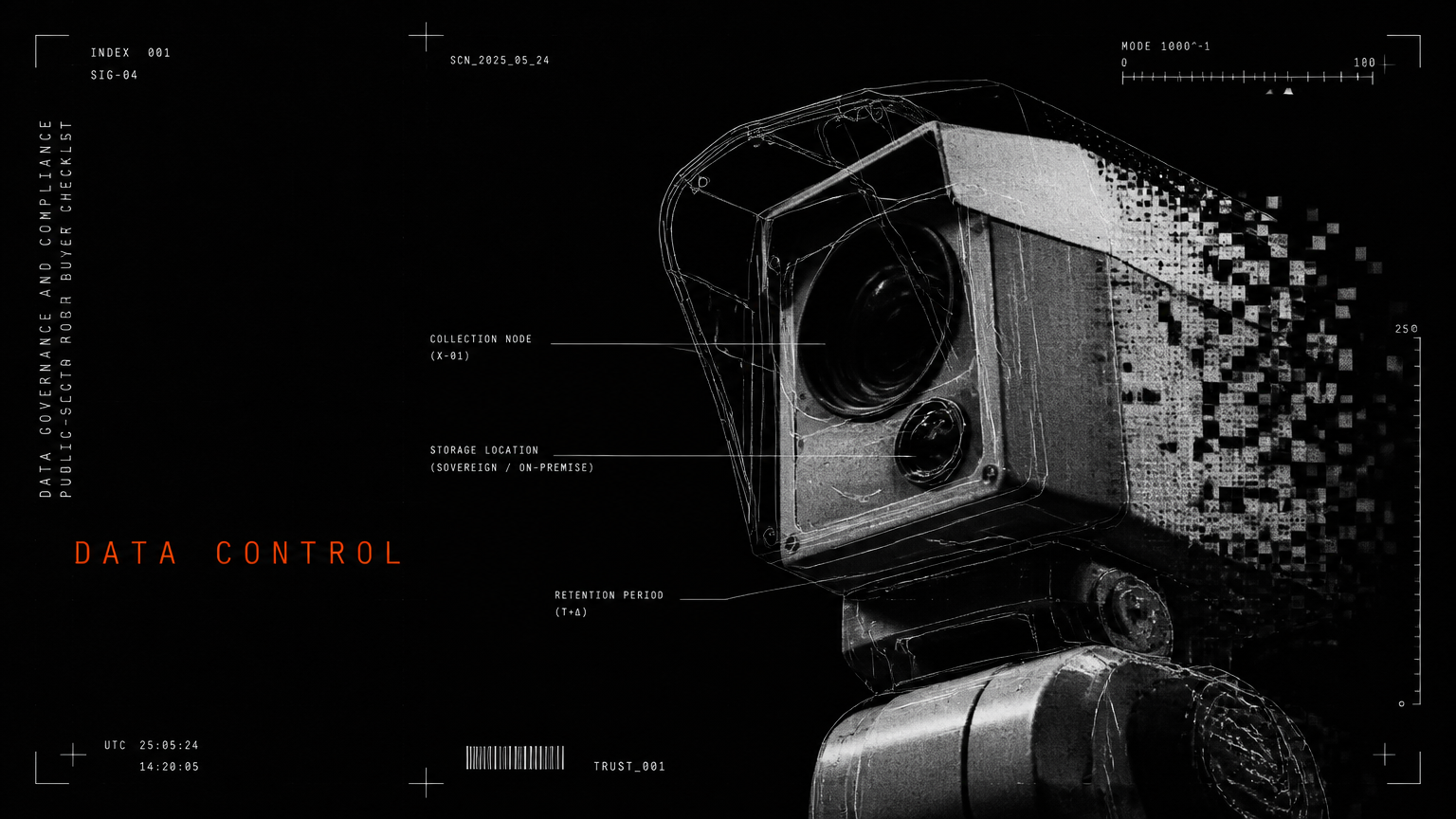
Quick Answer: Public-sector robot buyers should ask where robot data is collected, stored and processed, who owns it, how long it is retained, and how it complies with India's DPDP Act, GDPR, and standards like ISO 27001. They should require sovereign or on-premise storage options, audit logs, role-based access, and full IP and data-ownership clarity from in-house engineered platforms like Allbotix's fleet-management software. This guide to robot data governance and compliance gives procurement officers, IT heads, and compliance teams a practical checklist for citizen data privacy, transparency, and legal accountability.
Public-sector deployments are accelerating. Municipal corporations, transport hubs, government hospitals, universities, and administrative campuses are evaluating surveillance robots for 24/7 monitoring, AI receptionists for visitor management, and cleaning automation for large facilities — all while operating with tight staffing budgets. Unlike a private office pilot, public sector robotics compliance carries constitutional weight: citizen data privacy, data residency, public-service transparency, and auditability.
This article breaks down what to ask before you sign, and how in-house engineered fleets with proprietary software make government robotics data privacy manageable at scale.
Why Robot Data Governance and Compliance Is Now a Procurement Priority
Robots in public spaces are data systems on wheels. A single deployment can generate video, audio, location traces, visitor identities, and operational telemetry around the clock. Without clear governance, that creates legal, reputational, and operational risk.
Three forces have made AI robot compliance requirements for government non-negotiable:
1. India's DPDP Act, 2023 has changed the baseline. The Digital Personal Data Protection Act requires lawful purpose, notice, consent where applicable, purpose limitation, data minimization, reasonable security safeguards, retention limits, and breach notification. For government bodies acting as Data Fiduciaries, deploying robots that capture faces, voices, or ID details in lobbies, hospitals, and transit areas means you must be able to prove what was collected, why, where it went, and when it was deleted. That is the core of DPDP Act compliance for robots India.
2. Citizens expect transparency and control. 24/7 monitoring improves safety, but it also raises questions: Is footage stored in India? Who can watch live feeds? Can data be used for secondary analytics? Can a citizen request access or deletion? Procurement teams must show role-based access, anonymization options, and support for audits and RTI-type disclosure.
3. Fleet software determines risk. Hardware sensors collect data, but fleet-management software decides where it lives, who sees it, and how long it persists. Assembled robots built on third-party, black-box stacks often route diagnostics, maps, or video through overseas servers with limited audit visibility. In-house engineered platforms, such as Allbotix's proprietary AI fleet-management software with real-time monitoring and predictive maintenance, give buyers full IP ownership clarity, configurable storage, and detailed logs — critical for surveillance robot data governance.
Allbotix has developed 525+ robots for 180+ clients with 99.8% uptime, backed by publicly listed Nanta Tech Limited. Because design, firmware, source code, and trademarks are engineered in-house in India, public buyers get clearer answers on data flows than with assembled imports.
What Government Robots Collect and Where Fleet Data Lives
Effective government robot procurement checklist discussions start with data mapping. Different form factors create different privacy profiles.
| Surveillance / Patrol Robots | AI Receptionist Robots | Cleaning Automation Robots | |
|---|---|---|---|
| What It Collects | 360° video, audio alerts, thermal feeds, license plates, location tracks, anomaly events | Visitor name, phone, photo, ID scan, meeting host, voice queries, language preference | LiDAR maps, navigation paths, obstacle images, cleaning logs, area coverage, battery telemetry |
| Primary Privacy Risk | Continuous citizen capture in public zones, facial identification, 24/7 monitoring overreach | Direct personal data and consent management at front desk, minors and vulnerable visitors | Incidental capture of people in background, detailed indoor maps of sensitive facilities |
| Key Governance Control | Masking, zoned recording, retention limits, live-view authorization, incident-only storage | Notice display, multilingual consent, purpose-limited visitor CRM, auto-purge after visit | People-blurring, map access restrictions, no audio by default, operational-only retention |
| Retention Expectation | 7-30 days for general footage, longer only for flagged incidents with approval | 24 hours to 90 days per policy, with immediate deletion on request where lawful | Maps retained as facility asset, incidental imagery deleted within days |
| Access Model | Security control room + supervisor override with audit log | Front-desk staff + admin, no open export | Facility manager + maintenance team only |
Data Lifecycle: From Collection to Deletion
Ask vendors to walk through the full lifecycle in writing:
Collection and minimization: Does the robot collect only what is needed for its task? Can you disable audio recording, turn off facial recognition and use anonymous people-counting instead, or define no-record zones for prayer rooms, clinics, or restrooms?
Storage and residency: Where does fleet data live — on-robot edge storage, on-premise server in your data center, sovereign India cloud, or overseas public cloud? For government robotics data privacy, require India residency by default with on-premise or sovereign cloud options for sensitive sites like airports, courts, and hospitals.
Processing and anonymization: Is video analytics done on-edge or streamed to cloud? Are faces blurred by default? Are visitor logs tokenized? Can cleaning maps be stored without linked personal data?
Access and monitoring: Demand role-based access control (RBAC), multi-factor authentication, session timeouts, and immutable audit logs showing who viewed, exported, or deleted data and when. For 24/7 monitoring, require dual authorization for live feed export and automatic watermarking.
Retention and disposal: Insist on configurable retention policies, automated deletion, and cryptographic erasure certificates. Your policy — not the vendor's default — should govern how long data is retained.
Platforms that combine hardware fleets with proprietary fleet-management software make this easier to enforce centrally. With Allbotix, for example, facility heads can apply one retention and access policy across receptionist, cleaning, and surveillance form factors instead of managing three disconnected vendor portals.
Government Robot Procurement Checklist: AI Robot Compliance Requirements for Government
Use this government robot procurement checklist in RFPs, technical evaluations, and vendor demos. Require documentary evidence, not verbal assurances.
Data ownership and IP:
- Who owns all data collected by the robots — video, visitor records, maps, logs? Confirm 100% buyer ownership in the contract.
- Who owns the robot IP — design, firmware, source code, fleet software? Prefer full in-house IP ownership with Made-in-India manufacturing traceability.
- Will the vendor use your data to train models? Require explicit opt-in and anonymization, with opt-out as default for government.
Residency and architecture:
- Where is data stored, processed, and backed up, city and cloud-provider wise? Require India data residency and on-premise/sovereign cloud deployment options.
- What stays on-edge vs. what leaves the premises? Ask for a network data-flow diagram with ports, protocols, and encryption standards.
- What happens on network failure? Confirm offline operation with local buffering and no silent fallback to overseas servers.
Privacy and consent:
- How is notice and consent handled for DPDP Act compliance for robots India? Look for on-screen multilingual notice, QR-linked privacy policy, consent logs, and easy withdrawal.
- What anonymization controls exist? Require face-blurring, voice distortion options, license-plate masking, and people-count mode without identification.
Security and access:
- How is access controlled and logged? Require RBAC, MFA, SSO integration, encrypted transport (TLS 1.2+) and encryption at rest (AES-256), plus tamper-evident audit trails exportable to your SIEM.
- How are vulnerabilities managed? Ask for SBOM, patch SLAs, penetration test reports, and alignment to ISO 27001 controls, even if certification is in progress.
Transparency and audit:
- Can you support audits and RTI-type disclosure? Require incident reports, transparency summaries, retention proofs, and deletion certificates within defined timelines.
- What is the breach response process? Require notification within 72 hours or less, forensic log access, and a named 24/7 support escalation — such as Allbotix 24/7 Premium Support — with precision-engineered SLAs.
Document answers as annexures to the contract. For multi-site rollouts across corporate campuses, retail malls, education campuses, healthcare facilities, and transit hubs, the same checklist scales — only retention periods and access roles change.
Meeting Public Sector Robotics Compliance: DPDP Act, GDPR and ISO 27001
DPDP Act compliance for robots India is mandatory for Indian public deployments. GDPR still matters when foreign nationals, international airports, or EU vendor components are involved. ISO 27001 provides the operational backbone to prove both.
Focus on these proof points:
Lawful purpose and notice: Every robot use case needs a documented purpose — perimeter safety, visitor facilitation, hygiene auditing. Display clear signage and digital notice stating what is captured, why, retention period, and grievance contact.
Data minimization and accuracy: Configure surveillance robots for event-based recording rather than indiscriminate archiving. Configure AI receptionists to avoid collecting more ID fields than needed. Allow correction of visitor records.
Security safeguards: Encryption, network segmentation, secure boot, signed firmware updates, and centralized patching via fleet software. Ask how predictive-maintenance telemetry is separated from personal data.
Retention and principal rights: Demonstrate automated purging, access/export/deletion workflows, and nomination of a Data Protection contact. Your vendor should provide admin tools to fulfill these in days, not months.
Audit trails and transparency reporting: Immutable logs, quarterly access reviews, and annual compliance summaries build trust with oversight committees and citizens. This is where limitless innovation must meet public accountability.
In-House Engineered Platforms vs. Assembled Imports
| Criterion | In-House Engineered, Made-in-India Platform | Assembled Import with Third-Party Stack |
|---|---|---|
| IP and Source Code Ownership | Full ownership of design, firmware, source code, trademarks; buyer can audit logic | Fragmented IP across OEMs; limited visibility into firmware and analytics |
| Data Flow Transparency | Documented India-first architecture, configurable on-premise deployment | Opaque routing, potential overseas diagnostics or cloud dependency |
| Compliance Customization | Retention, masking, consent screens tailored to DPDP Act and site policy | Fixed defaults, slow change requests via overseas supplier |
| Audit and RTI Support | Direct log access, deletion proofs, named support team for audits | Brokered responses, delayed evidence, disclaimer-heavy SLAs |
| Supply Chain and Service | Aimtron Technologies manufacturing partnership, local spares, 24/7 Premium Support | Import lead times, third-party service agents, version drift across batches |
| Lifecycle Cost | Unified fleet software across receptionist, cleaning, AMR, cobot, humanoid fleets | Separate tools per robot type, higher integration and training cost |
For government buyers, the difference is not just patriotic procurement — it is operational control. When design and software are owned in-house, you can demand a code-level answer to where a frame goes. Allbotix, backed by Nanta Tech Limited, engineers machines to a client's specific precision, ambition, and scale rather than reselling off-the-shelf units, which is why audit and residency questions get straight answers.
How Robot Data Governance and Compliance Ensures Vendor Accountability and 24/7 Control
Compliance does not end at purchase. Public facilities need continuous assurance while robots patrol at 2 a.m., greet visitors at 9 a.m., and scrub floors overnight.
Choose Sovereign Storage by Site Sensitivity
| Criterion | On-Premise Deployment | Sovereign India Cloud | Global Public Cloud |
|---|---|---|---|
| Best For | Airports, courts, defense-adjacent sites, large government hospitals | Municipal bodies, universities, multi-city facility portfolios | Non-sensitive pilots with no personal data |
| Data Residency | 100% within buyer data center | Within India region with contractual guarantee | Varies by provider, requires explicit pinning |
| Live Monitoring Control | LAN-only viewing, no internet egress needed | Secure VPN + RBAC with India-hosted console | Internet-dependent, higher exposure surface |
| Audit Simplicity | Direct SIEM integration, physical disk control | Cloud audit logs + vendor attestation | Shared-responsibility model, complex evidence |
| Scalability | Capital-intensive, ideal for single large campus | Elastic across sites, faster rollout | Most elastic, least sovereign assurance |
Ask vendors to support all three and let your IT head decide per site. Proprietary AI fleet-management software should allow you to switch modes without replacing robots.
Harden 24/7 Monitoring Without Overreach
24/7 monitoring with tight staffing is the top driver for government and public services, but it must be bounded:
Define patrol routes, dwell limits, and escalation rules in software — for example, alert only on intrusion, smoke, or crowd density, not continuous face tracking. Require supervisor approval for PTZ zoom on individuals, automatic redaction for exports, and shift-wise access expiry for contract guards. Integrate alerts with your existing VMS and helpdesk so robots augment staff instead of creating an unmonitored parallel system.
With 99.8% uptime and predictive maintenance, Allbotix fleets are designed to stay available through night shifts and peak footfall while logging every intervention for later review — a practical balance of coverage and control for hospitals, transit hubs, and administrative blocks that cannot afford blind spots or privacy incidents.
Make Audits and Disclosure Routine
Build vendor accountability into operations: quarterly access-log reviews, semi-annual retention compliance checks, annual security review aligned to ISO 27001 Annex A controls, and a pre-agreed template for RTI-type responses that discloses purpose, retention, access list, and safeguards without exposing security configurations.
Require a single point of accountability for hardware, software, and data — not one vendor for the robot, another for the cloud, and a third for support. Cross-industry versatility matters here: the same accountability model that serves IT campuses and malls should extend to co-working parks, retail showrooms, universities, hospitals, hotels, plants, warehouses, and airports without re-negotiation.
Putting Robot Data Governance and Compliance into Practice with Allbotix
Public-sector innovation succeeds when citizen trust and operational efficiency move together. Start with a data-mapping workshop, pilot one building with India-resident storage and strict retention, validate audit logs with your IT and legal teams, then scale the policy fleet-wide through centralized software.
Allbotix engineers and deploys AI receptionists, cleaning robots, serving robots, AMRs, cobots, humanoids, dog robots, and surveillance robots on proprietary AI fleet-management software — all built in-house with full IP ownership, Made-in-India manufacturing scaled via Aimtron Technologies, and backing from publicly listed Nanta Tech Limited. That breadth lets government, education, healthcare, corporate, retail, hospitality, manufacturing, logistics, and transit teams standardize robot data governance and compliance once and apply it everywhere, supported by 24/7 Premium Support and precision engineering for your site's scale and ambition.
Talk to Allbotix to design a compliant, transparent, and audit-ready robotics deployment for your public facility — request a data-governance demo covering residency, RBAC, retention, and audit reporting at https://www.allbotix.ai/.