
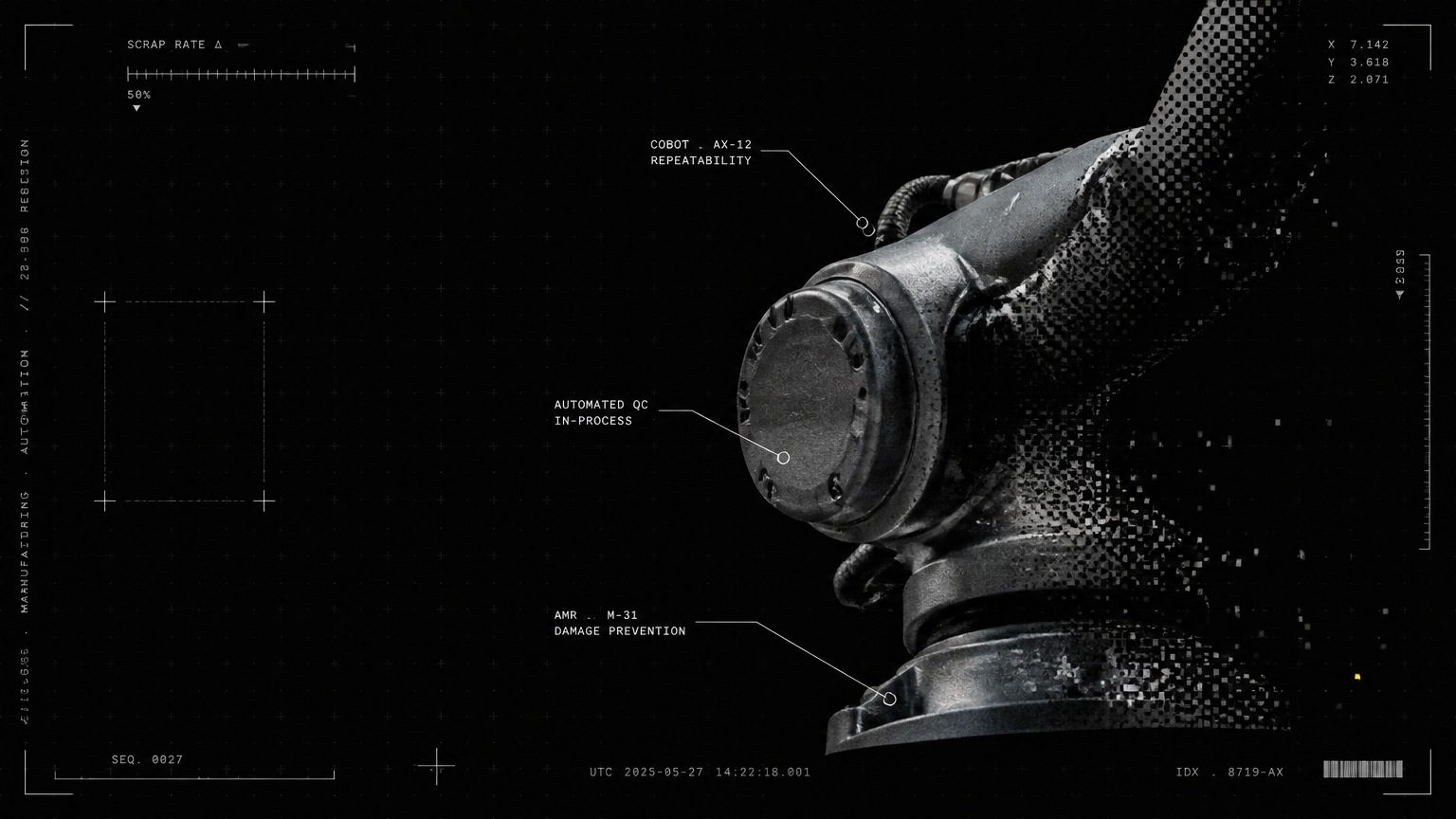
Scrap reduction in manufacturing of 20-50% is achievable when plants replace variable manual handling, inspection, and material flow with precision-engineered automation. Cobots ensure repeatable execution, AMRs prevent damage in transit, automated QC catches defects in-process, and predictive maintenance stops drift before it creates scrap. For plant leaders facing inefficiency, workforce shortages, and costly downtime, this is the fastest path to higher yield and payback in ~1.3 years.
Why Scrap Happens and How Automation Fixes It
Most scrap does not come from bad materials. It comes from variation.
Manual assembly applies inconsistent torque, pressure, and placement. Manual material handling causes drops, collisions, and mix-ups. Spot-check inspection misses defects until an entire batch is bad. And degrading equipment — worn tools, misaligned axes, overheating spindles — silently produces out-of-tolerance parts for hours.
Automation fixes all four root causes with limitless innovation in precision engineering:
1. Execution variation: Collaborative robots (cobots) repeat the same path with sub-millimeter accuracy, shift after shift, eliminating operator fatigue errors.
2. Transit damage: Autonomous Mobile Robots (AMRs) move pallets, bins, and work-in-progress on optimized, collision-free routes with stable handling.
3. Late detection: Automated QC with vision AI and sensors inspects 100% of parts in-cycle, not 5% offline, so corrections happen before scrap multiplies.
4. Machine drift: AI fleet-management with real-time monitoring and predictive maintenance flags vibration, temperature, and cycle-time anomalies before tolerance is lost.
With U.S. manufacturing facing a projected shortfall of 2M+ workers over the next decade, automation also closes the labor gap while lifting throughput 15-30% and overall capacity 20-40%.
Which Technologies Drive the Biggest Scrap Reduction
No single robot cuts scrap alone. Yield improves when execution, flow, inspection, and health monitoring work as one system.
| Criteria | Cobots | AMRs | Automated QC | Predictive Maintenance Software |
|---|---|---|---|---|
| Primary scrap cause solved | Assembly and handling variation | Transit damage, line starvation, mix-ups | Undetected defects and rework | Tool wear, misalignment, unplanned stops |
| How it works | Repeatable pick, place, screw, weld, and machine-tending with force control | Autonomous pallet and tote transport with fleet orchestration | Vision AI + sensors for 100% in-line dimensional and surface inspection | 24/7 condition monitoring, anomaly alerts, maintenance scheduling |
| Best-fit application | High-mix assembly, CNC tending, packaging | Plants with frequent forklift traffic and WIP movement | Automotive, electronics, pharma, precision components | High-utilization lines with costly downtime |
| Scrap and uptime impact | Consistent quality, less rework | Fewer damaged parts, steadier flow | 20-50% scrap reduction via early containment | 30-50% cut in unplanned downtime |
Plants typically see the largest immediate gain from automated QC combined with cobots, then compound savings when AMRs and predictive maintenance stabilize flow and equipment health.
Implementation Path: From Pilot to Plant-Wide in 90 Days
You do not need a rip-and-replace project to start seeing scrap reduction in manufacturing.
Days 1-30: Scrap audit and pilot cell Map top scrap codes by station, shift, and SKU. Deploy one cobot cell for your highest-scrap operation plus in-line vision inspection. Connect machines to a fleet-management dashboard for baseline OEE, cycle time, and defect rate.
Days 31-60: Stabilize flow and control Add AMRs for the pilot line's inbound and outbound moves to remove forklift damage and delays. Set automated QC rules to auto-quarantine suspect parts and alert operators with images and measurements.
Days 61-90: Predict and scale Enable predictive maintenance thresholds for vibration, temperature, and tool life. Standardize successful recipes across 2-3 more lines. Train operators to supervise robots, handle exceptions, and own continuous improvement.
This phased approach de-risks investment, proves yield lift on one line, and creates SOPs for scale. Look for a partner that engineers to your precision, ambition, and scale — not off-the-shelf boxes — with in-house design, firmware, and 24/7 Premium Support.
The ROI of Lower Scrap, Less Downtime, and Higher Yield
Scrap is pure margin loss: wasted material, labor, energy, and capacity. Cutting it moves directly to profit.
Well-run deployments now pay back in ~1.3 years, down from ~5.3 years in 2019, with 10:1 to 30:1 ROI within 18 months. Automation and condition-based monitoring cut unplanned downtime 30-50%, with documented cases showing 26%+ reductions and ~$630K in annual savings per plant.
Example math: a plant scrapping 8% on $20M in annual production value loses $1.6M to scrap. A 50% reduction saves $800,000 per year before counting avoided rework, overtime, expedited freight, and customer claims. Add throughput gains and the case for automation becomes operational, not just financial.
Build Scrap Reduction on a Fleet, Not a Single Robot
Allbotix engineers and deploys a broad, multi-vertical fleet — AMRs, cobots, humanoids, cleaning, serving, receptionist, and quadruped platforms — paired with proprietary AI fleet-management software for real-time monitoring and predictive maintenance. With 525+ robots developed, 180+ happy clients, 99.8% uptime, and backing from publicly listed Nanta Tech Limited, the platform is built in-house with full IP ownership and Made-in-India manufacturing.
That same fleet approach proven in logistics, healthcare, hospitality, retail, education, and corporate campuses brings cross-industry versatility to industrial parks and plants.
Ready to cut scrap by up to 50% and stabilize yield? Partner with Allbotix to audit your top scrap drivers and deploy a precision-engineered cobot, AMR, and automated QC pilot built for your line.