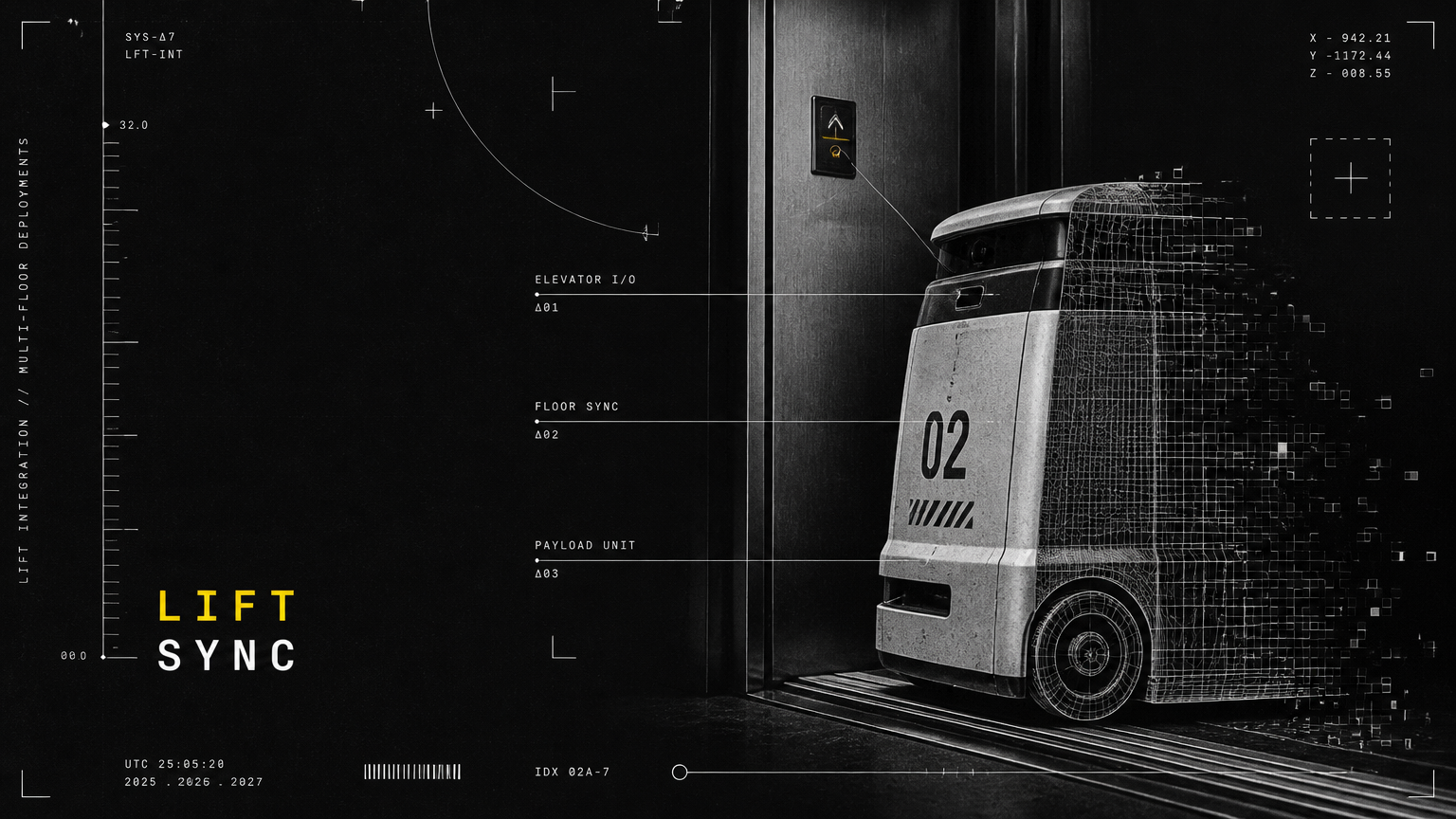
Robots access multi-floor buildings by integrating with elevators through methods like elevator control APIs, relay/IO emulation, building BMS/IoT middleware, or certified service elevator interfaces; fleet-management software coordinates requests, security credentials, and routing to ensure safe, predictable rides. Successful deployments require safety interlocks, access-control integration, elevator reservation/priority policies, and ongoing monitoring/predictive maintenance to keep uptime high across verticals.
Part of our guide to How Robots Actually Work: How Does an Autonomous Robot Navigate a Building? SLAM, LiDAR and Vision Explained.
How Robots Use Elevators: Lift Integration for Multi-Floor Deployments
robot elevator integration is the technical and operational bridge that lets AMRs, service robots, and other robotic form factors move reliably between floors. For facility managers, robotics engineers, and operations leaders, this guide explains integration architectures, safety and compliance needs, and operational design patterns that make multi-floor robot deployments predictable and high‑uptime.
Why elevator integration for robots matters now
Multi-floor capability unlocks new automation value: housekeeping robots covering multiple floors, delivery AMRs serving cafeterias and offices, receptionists guiding visitors between levels, and inspection robots supporting manufacturing and maintenance. Without reliable elevator access, many automation ROI cases break down because robots are constrained to single-floor islands or require costly human assistance.
Allbotix brings practical deployment experience to this problem: our in-house engineered fleet (525+ robots across receptionist, humanoid, dog, cleaning, serving, AMR, and cobot form factors), proprietary AI fleet-management software, and 24/7 Premium Support have delivered 99.8% uptime for 180+ clients. We design solutions with "limitless innovation" and "precision engineering" to minimize human interventions in daily elevator-handling workflows.
Integration methods for robot elevator integration
There are four widely used technical approaches to connect robots to elevators. Each has trade-offs in speed, cost, security, and vendor dependence.
| Criterion | Elevator Control APIs (Direct) | Relay / IO Emulation | BMS / IoT Middleware | Vendor/Retrofit Modules |
|---|---|---|---|---|
| Integration complexity | Medium–High (depends on vendor docs) | Low–Medium (hardware wiring) | Medium (middleware mapping required) | Low (plug-and-play retrofits) |
| Retrofit friendliness | Usually limited to newer elevator systems | High (works with older panels) | High (central integration) | High (designed for retrofits) |
| Security posture | Strong (tokenized APIs, logging) | Weak–Medium (physical circuits need controls) | Strong (central auth possible) | Varies (vendor-dependent) |
| Latency & responsiveness | Low (fast command/feedback) | Low (near-instant) | Medium (network hops) | Low–Medium |
| Vendor dependence | High (elevator OEM APIs differ) | Low (panel-level interface) | Medium (BMS vendors differ) | Medium–High |
| Cost (hardware + integration) | Medium–High | Low–Medium | Medium | Medium–High |
| Scalability across buildings | Medium (requires API access per site) | Medium (per-site wiring) | High (standardized BMS integration) | Medium |
| Recommended use cases | New builds, modern smart elevators | Legacy elevators, small retrofit budgets | Campuses, enterprise rollouts | When OEM-supported retrofit exists |
Key takeaways:
- Use native elevator control APIs when available for the best security and reliability.
- Relay/IO emulation is often the practical choice in older buildings.
- BMS/IoT middleware helps scale across multiple buildings under consistent policies.
- Retrofit modules reduce project friction when validated by elevator vendors.
Hardware and software roles: AMR elevator integration vs service robot elevator integration
Design choices differ by form factor and use case. The table below summarizes typical differences and requirements.
| Criterion | AMR Elevator Integration | Service Robot Elevator Integration | Fleet-Management Software Role |
|---|---|---|---|
| Typical payload & footprint | Medium–High payloads, standardized footprint | Variable (trolleys, trays, humanoid posture) | Abstracts vehicle profiles and elevator capacity |
| Elevator-door interactions | Payload-stable, may require docking | Needs careful door/timer coordination to avoid spills | Orchestrates door commands and timing windows |
| Localization & navigation | Lidar/odometry for precise stance at door | Vision + proximity for human-safe interactions | Coordinates staging positions and retries |
| Safety sensors near doors | Bumpers, LIDAR, proximity | Human-detection, force-limited manipulators | Enforces occupancy limits & interlocks |
| Common integration method | API or relay + hardware latching | API + human-safety middleware | Central scheduler, authentication, logging |
| Fleet behavior needs | High concurrency, elevator reservation | Priority queuing for passenger service | Global route planning & ride batching |
| Typical failure modes | Missed call, door close on payload | Door misalignment, human obstruction | Retry logic, reroute to alternate elevator |
Fleet-management software is the glue: it schedules elevator requests, assigns priority, manages credentials (badge or digital certificates), logs rides for traceability, and handles retries and escalations. Allbotix’s proprietary AI fleet-management layer bundles elevator orchestration with predictive maintenance and real-time health telemetry to achieve enterprise SLAs.
Safety, compliance, and building operations
Robots entering elevators introduce unique safety and regulatory concerns. Address them early with building owners, elevator vendors, and compliance teams.
Key topics and recommended controls
- Fire and evacuation rules: Under most fire codes (e.g., EN 81, ASME A17.1 guidelines—consult local code), passenger elevators may be disabled during alarms or revert to firefighter service. Ensure robots are coded to never use elevators during emergency states and that the fleet-management system receives-fire-alarm signals.
- Access control and security: Integrate with the building’s access-control system. Robots should use scoped, auditable credentials and be limited to authorized floors/areas. Use short-lived tokens and mutual TLS where possible.
- Passenger-safety interlocks: Elevators should only accept robot calls when occupancy sensors or weight verification confirm safe capacity. Force and contact sensors on robots ensure they stop before damaging doors or items.
- Testing and validation: Conduct staged acceptance tests: normal operations, congestion, elevator faults, fire alarm, power loss, and emergency stop. Log every test and collect telemetry for sign-off.
- Liability and insurance: Update insurance and operational agreements to cover robot elevator rides, especially for payload transfer scenarios.
- Certification: Work with elevator OEMs when retrofitting control logic; some vendors require certified retrofit modules or witnessed integration tests.
Designing operational policies for multi-floor robot deployments elevators
Technical integration must be paired with operational rules to keep traffic predictable and fair.
| Policy Dimension | Option A: Reservation & Priority | Option B: First-Available Shared | Option C: Time-Slot & Batch |
|---|---|---|---|
| Best for | High-priority deliveries, healthcare, manufacturing | Low-cost, casual passenger spaces | High-density peak times (malls, airports) |
| Latency impact | Lower for priority jobs | Variable | Predictable for batch workflows |
| Complexity to implement | Medium–High | Low | Medium |
| Scalability | High with fleet-manager | Medium | High with scheduler |
| Typical use cases | Hospitals, manufacturing | Offices, small hotels | Airports, large retail |
Operational design patterns
- Reservation + pre-book window for critical cargo (med supplies, production parts).
- Batch rides for cleaning robots during off-peak hours.
- Priority lanes / express rides for emergency or high-value tasks.
- Dynamic throttling during peak foot traffic; hold non-urgent trips.
- Staging buffer zones outside elevator doors for retries and queuing.
Monitoring, predictive maintenance, and KPIs
Keeping elevator-enabled robot fleets healthy requires operational telemetry and maintenance strategies.
Primary KPIs to track
- Elevator ride success rate (%) per day
- Mean time to resolve elevator-related faults (MTTR)
- Average wait time for elevator per robot task
- Fleet idle time caused by elevator unavailability
- Uptime (Allbotix standard: 99.8% achieved on multi-vertical deployments)
- ROI metrics: reduced labor hours, throughput gains, and payback period (well-run deployments often see paybacks under 18 months)
Predictive maintenance
- Correlate elevator faults with robot ride metrics and door-close cycles.
- Use fleet telemetry to spot repeated fails at specific shafts (indicating elevator control or sensor issues).
- Schedule preventive maintenance during low-demand windows; Allbotix’s predictive algorithms can surface anomalies before they impact service.
Validation checklist for deployment engineers and facility managers
- Confirm elevator-interfacing method and get OEM sign-off.
- Map emergency service modes and ensure robot behavior in each mode.
- Integrate with access-control and fire/life safety systems.
- Define elevator reservation, priority, and peak-time policies with stakeholders.
- Build staging and queuing spaces with safe clearances.
- Run full acceptance tests (normal, congestion, alarm, power loss).
- Implement telemetry dashboards and automated incident escalations.
- Train on-site staff and provide clear SOPs for manual override and rescue.
Vertical considerations: tailoring elevator integration across sites
Different verticals have distinct constraints and priorities. Examples:
- Healthcare: strict priority for medical deliveries, zero tolerance for elevator downtime during codes—use reservation + guaranteed rides.
- Hospitality & Retail: guest experience matters; service robots and guests may share elevators—favor friendly interactions, occupancy sensing, and human-centered timing.
- Manufacturing & Logistics: heavy payloads and tight cycles—prefer direct API or certified retrofit to guarantee throughput and tight SLA adherence.
- Education & Government: mixed building ages—relay/IO emulation and BMS middleware often needed for retrofits across campus buildings.
Allbotix’s multi-vertical experience lets teams choose the right integration path quickly, with an approach tuned to the facility’s risk profile and traffic patterns.
Practical deployment timeline (typical)
- Week 0–2: Site survey, vendor engagement, preliminary architecture (API vs relay vs retrofit).
- Week 3–6: Hardware install (retrofit or IO wiring), security/credentials setup, fleet-manager integration.
- Week 7–10: Staging, acceptance tests, staff training, policy finalization.
- Week 11+: Live operations with monitoring, incremental optimizations, and SLA tracking.
Allbotix’s deployments follow a structured program that emphasizes staged validation and continuous improvement—backed by 24/7 Premium Support and in-house engineering expertise to evolve integrations as building systems change.
Conclusion: Operationalize elevator integration with precision engineering
Elevator integration for robots is both a technical and operational challenge. The right mix of integration method, safety controls, operational policies, and monitoring determines whether a multi-floor deployment will be reliable and cost-effective.
Allbotix combines a broad, fully in-house fleet (525+ robots), proprietary AI fleet-management software, and deep multi-vertical deployment experience to deliver practical, scalable elevator integrations. Our approach balances "limitless innovation" with "precision engineering" to produce predictable rides, audited security, and measurable ROI. If you’re planning multi-floor automation—whether AMRs moving parts in a plant, cleaning fleets in an office tower, or service robots in a hotel—partnering with an experienced integrator reduces risk and accelerates value.
Contact Allbotix to evaluate your site and get a tailored plan for robot elevator integration. Our engineers will map options, run required tests with your elevator vendor, and deliver an operational model that keeps robots moving and your operations running.