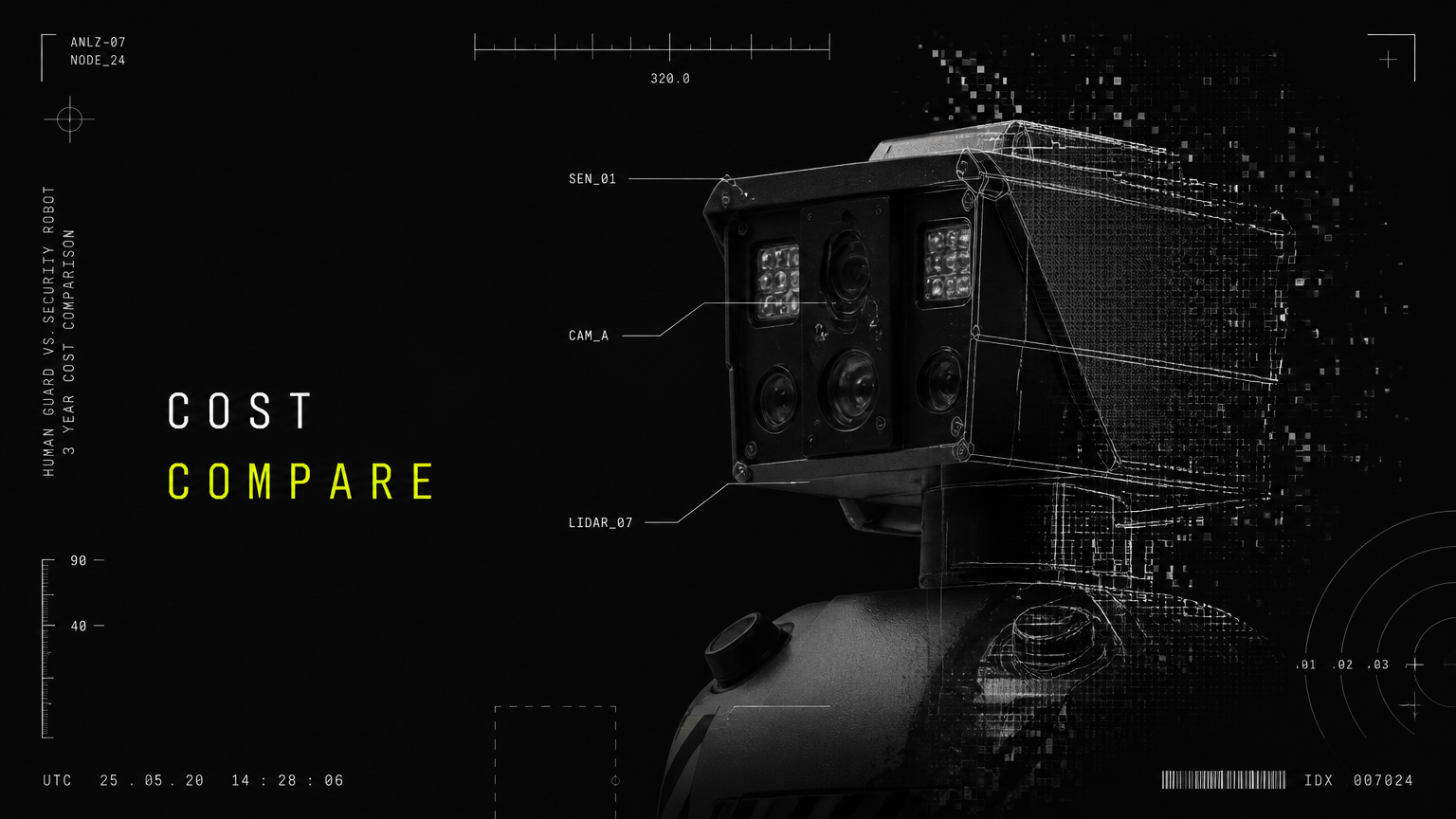
Quick Answer: Over 3 years, providing true 24/7 coverage with human guards typically costs far more than deploying a security patrol robot due to wages, overtime, turnover, training, and supervision across multiple shifts. For corporate campuses, hospitals, retail, warehouses, and transit hubs, security robots lower total cost of ownership by handling continuous patrol, deterrence, and monitoring, while human teams focus on incident response and decision-making. If you are evaluating security robot vs security guard cost, the real difference is not one salary versus one machine, it is the cost of 4.2 full-time posts to cover one 24/7 position versus one always-on autonomous system supported by fleet-management software.
For facility, operations, and security leaders, this comparison is now a budget decision. Labor rates are rising, turnover in guarding remains high, and campuses are getting larger and more complex to patrol. This guide breaks down security robot cost, coverage performance, and security robot ROI for business, so you can decide when to automate, when to retain humans, and when a hybrid model wins.
security robot vs security guard cost: 3-Year Total Cost of Ownership Breakdown
True 24/7 coverage never means one guard. To cover one post 24 hours a day, 7 days a week, 365 days a year, you need 168 hours per week of coverage. At 40 hours per guard, that is 4.2 full-time equivalents before sick leave, vacation, training days, and attrition. Most sites also need a supervisor, overtime buffer, uniforms, insurance, and a control-room operator to make patrols useful.
That is why 24/7 security guard cost per year surprises many finance teams. A single guard salary looks manageable. A fully staffed, supervised, always-filled 24/7 post over three years does not.
By contrast, an autonomous patrol robot is designed for continuous operation with charging or battery-swap cycles, remote monitoring, and predictive maintenance. You still budget for deployment, connectivity, software, and support, but you do not multiply cost by 4.2 shifts or restart hiring every 6 to 12 months.
| 3-Year Total Cost Factor | 24/7 Human Guard Post (4.2 FTEs to Cover 1 Position) | Autonomous Security Robot Patrol (1 Unit for Routine Patrol) |
|---|---|---|
| Base wages for continuous coverage | 4.2 salaries x 3 years, plus annual increments and site differentials for nights/weekends | No wages; one-time deployment plus annual software/service subscription |
| Overtime, holiday pay, and gap fill | High and recurring for sick cover, vacancies, events, and extended shifts | Minimal; robot maintains schedule, fleet software reallocates patrols automatically |
| Hiring, turnover, and training | Repeated background checks, licensing, uniforms, onboarding; industry turnover often 40-100% annually | One-time commissioning, mapping, and SOP integration; refresher training via software updates |
| Supervision and management | Shift supervisors, attendance tracking, QA checks, incident report review | Centralized dashboard with real-time monitoring, video audit trails, and automated reports |
| Reliability and consistency | Varies by fatigue, staffing gaps, and experience level | Consistent patrol speed, routes, and sensor checks with 24/7 logging |
| Insurance, liability, and compliance | Workers compensation, liability exposure during patrols and interventions | Lower personnel exposure for routine patrols; humans reserved for judgment-led response |
| Scalability to add coverage | Add full headcount per post and shift | Add routes, schedules, or units with centralized fleet management |
How much does a security robot cost over 3 years?
Leaders often ask: how much does a security robot cost and what drives autonomous security robot price? The honest answer is that security robot cost depends on sensors, autonomy stack, patrol environment, integration, and service level. Most commercial models use a Robot-as-a-Service structure: an initial deployment fee for mapping, systems integration, and training, plus a monthly fee covering the robot, AI fleet-management software, connectivity, maintenance, and 24/7 support.
Over three years, that structure is predictable. You can forecast cost per patrol route, cost per square foot covered, and cost per deterred incident. There are no overtime spikes, no emergency agency-guard premiums, and no retraining costs after resignations. For multi-site portfolios, the economics improve further because one control-room team can supervise multiple robots across locations.
Allbotix follows this enterprise approach. It engineers surveillance and service robots in-house rather than assembling off-the-shelf parts, paired with proprietary AI fleet-management software for real-time monitoring and predictive maintenance. With 525+ robots developed, 180+ happy clients, and 99.8% uptime, and backed by publicly listed Nanta Tech Limited, Allbotix is built for multi-year, multi-site ownership, not pilot-only deployments.
The hidden 3-year cost of guards alone
Base salary is only 60-70% of the true 24/7 security guard cost per year for continuous posts. The rest is overtime to fill no-shows, agency premiums during hiring gaps, supervisor time, repeat training, uniform and equipment refresh, and management time spent on rostering and incident documentation.
Over three years, three hidden drivers dominate. First, turnover resets performance. New guards need site familiarization, which creates patrol inconsistency and missed checkpoints. Second, fatigue and monotony reduce deterrence. Routine night patrols of parking lots, perimeters, and warehouses are critical but difficult to sustain with equal vigilance. Third, limited auditability increases risk cost. Without continuous video, location logs, and automated escalation, investigations take longer and liability exposure rises.
Robots do not eliminate human guards. They eliminate the most expensive way to use humans: paying highly capable people to walk empty corridors all night and then paying again to replace them when they leave.
security robot vs security guard cost Beyond Salary: Coverage, Reliability and Risk
Cost without performance is misleading. The right security guard vs robot patrol comparison must measure what security actually buys: deterrence, detection, response time, evidence quality, and consistency across every shift for three years.
Humans excel at judgment, de-escalation, empathy, and complex incident response. Robots excel at persistence, coverage, sensing, and documentation. Over a 3-year horizon, guards alone struggle with continuity, while robots alone cannot arrest, comfort, or negotiate. That is why performance comparison favors a hybrid, but shows why routine patrol is the ideal workload to automate.
| Performance Criterion (3-Year View) | Human Guard Alone | Security Patrol Robot with Remote Monitoring |
|---|---|---|
| 24/7 patrol consistency | Declines on nights, weekends, and during staff shortages; route adherence varies | Fixed routes, schedules, and dwell times with automated missed-checkpoint alerts |
| Deterrence presence | Strong when visible, but limited to one location at a time | Highly visible, illuminated mobile presence with cameras and two-way audio; covers larger area per shift |
| Detection capability | Eyes and ears, radio, flashlight; limited in dark, large, or hazardous zones | 360-degree cameras, thermal imaging, LiDAR, anomaly detection, license-plate and people analytics depending on configuration |
| Real-time monitoring and escalation | Manual radio/phone escalation; dependent on supervisor availability | Live video stream to control room, automatic alerts, and integration with VMS/access control |
| Transparency and audit trail | Handwritten or app-based reports; gaps during busy periods | Time-stamped video, patrol heatmaps, sensor logs, and incident clips for compliance and insurance |
| Fatigue, turnover, and knowledge loss | High impact over 3 years; site knowledge walks out the door | Patrol intelligence stays in the system; maps, SOPs, and history persist across software updates |
| Safety for personnel | Guards exposed during isolated night patrols and hazardous areas | Robot takes first pass in dark basements, perimeters, and plants; humans respond with full context |
For government and public services, healthcare, education, and airports, that audit trail matters as much as cost. Continuous logs support transparency, faster investigations, and clearer compliance reporting. For retail, hospitality, and corporate campuses, consistent visitor-area patrols improve both safety perception and brand experience without adding headcount.
Allbotix strengthens this layer with its software-first model. Because design, firmware, and fleet-management software are owned in-house, patrol data, predictive maintenance alerts, and 24/7 Premium Support are part of one system. That precision engineering approach, built with Made-in-India manufacturing scaled via its Aimtron Technologies partnership, is designed to keep patrol consistency high across years two and three, when many hardware-only deployments degrade.
security robot ROI for business: When a Hybrid Guard-Plus-Robot Model Wins
Full replacement is rarely the goal. The highest security robot ROI for business comes from reallocating labor: let robots own dull, distant, and dangerous routine patrols, and let humans own response, investigation, customer interaction, and decisions.
In a typical hybrid, one robot covers 2 to 4 times the ground of a foot patrol per night on parking structures, perimeters, warehouses, and lobbies, while one operator supervises multiple units. The site can reduce overtime posts, eliminate a night-shift gap-fill post, or avoid adding a second post as the facility expands. Savings compound in years two and three as hiring cycles drop and incident evidence improves.
| Vertical and Site Type | Robot Handles Routine Patrol and Monitoring | Human Team Focuses on Response and Experience |
|---|---|---|
| Corporate IT campuses and office parks | Night perimeter and parking patrol, lobby drive-throughs, after-hours anomaly checks | Access decisions, employee safety escorts, incident command, VIP support |
| Government and public facilities | 24/7 facility monitoring, transparent video logs, public-area deterrence | Citizen assistance, enforcement, emergency coordination |
| Retail malls and large-format stores | Closing-time sweeps, back-of-house corridors, parking lot deterrence, footfall analytics support | Customer service, loss-prevention intervention, tenant liaison |
| Universities and training centers | Sprawling campus routes, dorm perimeters, late-night pathway patrols | Student welfare response, event security, investigations |
| Hospitals and clinics | Corridor and parking patrol, non-clinical monitoring load, night-shift coverage strain | Patient and staff safety, de-escalation, clinical coordination |
| Hotels, resorts, and event spaces | Pool, banquet, and parking patrols during peaks, consistent night rounds | Guest experience, conflict resolution, emergency response |
| Manufacturing plants and industrial parks | Perimeter, tank farms, and hazardous zones, integration with safety SOPs | EHS response, contractor management, root-cause analysis |
| Logistics warehouses and 3PL hubs | Aisle perimeters, dock doors, yard patrols with continuous video | Inventory incident response, driver verification, operations continuity |
| Airports and transit hubs | High-density concourse loops, parking and curbside deterrence | Passenger assistance, threat assessment, agency coordination |
This playbook explains why Allbotix positions breadth as an advantage. The same organization that deploys AI receptionists, cleaning automation, AMRs, cobots, and humanoids can align security patrol with front-desk automation and facility cleaning under one fleet-management view. For a hospital, that means a security robot, a cleaning robot, and a delivery AMR share maps and monitoring discipline. For a mall or airport, patrol, greeting, and cleaning fleets create both safety and experience uplift without multiplying vendors.
Limitless innovation here means practical: machines engineered to a client's specific precision, ambition, and scale, not generic off-the-shelf units forced onto complex sites.
How to calculate your 3-year comparison in 4 steps
First, define one 24/7 post fully loaded. Multiply average guard cost by 4.2, add 15-25% for overtime and agency cover, then add supervision, hiring, training, uniforms, and turnover replacement over three years. Second, map routine patrol hours that do not require human judgment: perimeter loops, parking checks, after-hours rounds, and fixed checkpoint visits. Third, price the robot deployment for those routes, including software, connectivity, maintenance, and support, and model one control-room operator covering multiple units. Fourth, quantify avoided costs: reduced overtime posts, fewer incident investigation hours, lower liability exposure, and deferred headcount as you expand.
Most corporate, healthcare, logistics, and education sites find the crossover in year one to year two, with years two and three delivering compounding savings because robot operating cost stays flat while labor cost rises.
Choose Consistency for 3 Years, Not Just Coverage for Tonight
Guards bring courage and judgment no machine can replace. Robots bring stamina, sensing, and memory no roster can sustain for 1,095 consecutive nights. Evaluated over three years, routine patrol is simply a poor use of expensive, high-turnover human hours.
If your priority is safer campuses, hospitals, malls, plants, warehouses, and transit hubs with transparent, auditable, always-on deterrence, start with a hybrid pilot on your hardest-to-staff routes and measure overtime reduction, patrol completion, response time, and incident documentation quality.
Talk to Allbotix to model security robot vs security guard cost for your site. With in-house engineering, proprietary AI fleet management, 24/7 Premium Support, and a proven multi-vertical fleet, Allbotix will help you design a guard-plus-robot deployment that lowers 3-year total cost while raising coverage. Visit https://www.allbotix.ai/ to request a site assessment and 3-year ROI estimate.