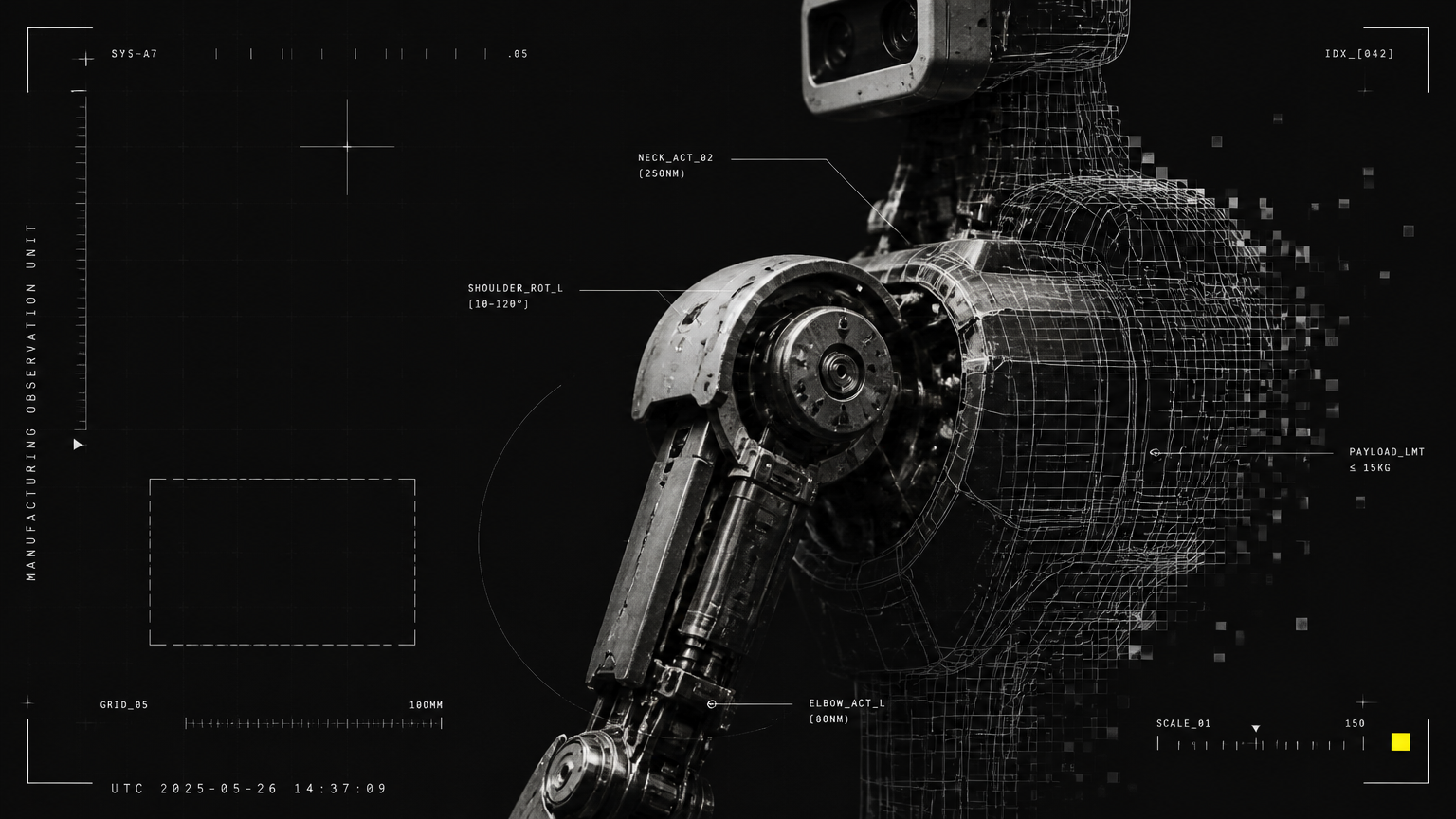
Humanoid robots in manufacturing can today handle light material handling, machine tending assistance, visual inspection support, and intra-facility delivery in structured zones. They can't yet match human dexterity, speed, or judgment for complex assembly, unstructured troubleshooting, or high-payload work.
For manufacturing and operations leaders facing workforce shortage, downtime, and inefficiency, that distinction matters. Here is a hype-free breakdown of where humanoids add value now, where they fall short, and how to pilot them correctly.
What Humanoid Robots in Manufacturing Can Do Right Now
Current-generation humanoids work best in defined, repetitive workflows alongside people and existing automation. Practical deployments include:
- Tote and parts transport: Pick up bins, kits, and components from a rack or conveyor and deliver to the next cell
- Machine tending assistance: Load/unload lighter parts, press cycle-start buttons, and alert operators to faults
- Visual checks and data capture: Use vision + AI to verify presence/absence, read gauges, scan labels, and log results to fleet-management software
- Training and assistance roles: Guide new operators through SOPs, demonstrate safe workflows, and provide multilingual instructions on the floor
- Light facility support: Support 5S audits, patrol aisles after shifts, and carry tools or documentation between stations
When integrated with proprietary AI fleet management with real-time monitoring and predictive maintenance, these tasks deliver measurable gains. Manufacturing deployments using automation and condition-based monitoring cut unplanned downtime 30-50%, with documented cases showing 26%+ reductions and ~$630K in annual savings per plant. Consistent robotic execution also reduces scrap rates 20-50%.
Where Humanoids Still Fall Short
Humanoids are not ready to replace skilled operators or fixed automation for heavy or high-precision work. Current limitations include:
- Payload and speed: Most humanoids handle 5-20 kg and move slower than purpose-built AMRs or conveyors. They are not pallet movers.
- Dexterity: Two-handed manipulation of wires, flexible parts, oily components, or tight-tolerance assembly remains unreliable without fixtures and human oversight.
- Battery and uptime: 2-4 hour effective runtime per charge in active use requires charging strategy and task rotation to maintain flow.
- Safety and validation: Humanoids need mapped zones, speed limits, and risk assessment for close human interaction. Unstructured aisles with forklifts and clutter are not day-one environments.
- Integration effort: Value comes from connection to MES/WMS, PLC signals, and fleet software — not from the robot walking alone. Without that integration, pilots stall.
Bottom line: deploy humanoids for ergonomics, coverage, and consistency in light tasks. Keep heavy lifting, high-speed pallet transport, and precision assembly on AMRs, conveyors, and cobots.
Humanoids vs AMRs vs Cobots: Where Each Fits
Use the right form factor for the job. All three solve labor and efficiency gaps, but in different zones of the plant.
| Criterion | Humanoid Robots | AMRs | Cobots |
|---|---|---|---|
| Primary Job | Light handling, tending assist, inspection, guidance in human-designed spaces | Autonomous transport of pallets, carts, and bins across facilities | Stationary pick, place, screw, polish, and assembly assist at a workstation |
| Payload & Throughput | Low payload, moderate speed; best for totes and kits | High payload, continuous flow; best for pallet transport and inventory movement | Medium payload, high repeatability; best for quality and consistency |
| Navigation | Bipedal, uses stairs and tight human areas, needs structured paths | LiDAR/SLAM navigation for aisles and docks, fleet coordination | Fixed or rail-mounted, works in defined cell with vision and force sensing |
| Human Interaction | Conversational guidance, training, and alerts | Minimal interaction, traffic management and safety stops | Direct collaboration with force-limited safety |
| Deployment Complexity | Medium-high: mapping, integration, SOP redesign | Medium: mapping, fleet rules, WMS integration | Low-medium: cell design, end-of-arm tooling, PLC integration |
| Best Pilot Metric | Labor coverage for non-value tasks, ergonomic relief, audit compliance | Fleet visibility, travel time saved, pallet moves per shift | Scrap reduction, cycle time, first-pass yield |
Well-run automation programs close the workforce gap with 15–30% throughput increases and 20–40% capacity uplift overall. The fastest payback comes from assigning each task to the platform built for it, managed under one software layer.
Should You Pilot Humanoids to Address Workforce Shortage and Downtime?
Yes — if you have a specific labor gap and a structured pilot area. Manufacturing faces a projected shortfall of 2M+ workers over the next decade. Average robot payback time dropped from ~5.3 years in 2019 to ~1.3 years in 2024, with well-run deployments seeing 10:1 to 30:1 ROI within 18 months.
Pilot humanoids when you have:
- Repetitive walking, carrying, or checking tasks that pull skilled operators away from machines
- Night-shift or weekend coverage gaps that cause idle machines and downtime
- High turnover in material handling or inspection support roles
- A defined cell or aisle where routes, safety zones, and success metrics can be locked for 60-90 days
Start with one use case, one KPI, and one integration point. Examples: reduce machine idle time by 20%, cut operator walking distance by 30%, or achieve 99%+ scan compliance on outbound kits.
Start With a Fleet, Not a Single Robot
Humanoids deliver more value as part of a coordinated fleet. Allbotix engineers and deploys receptionist, humanoid, cleaning, serving, AMR, and cobot form factors with proprietary AI fleet-management software for real-time monitoring and predictive maintenance.
Built in-house with full IP ownership of design, firmware, and source code — not assembled from off-the-shelf parts — and manufactured in India scaled via Aimtron Technologies partnership, the approach is precision engineering for your specific scale and workflow. With 525+ robots developed, 180+ happy clients, 99.8% uptime, and 24/7 Premium Support backed by publicly listed Nanta Tech Limited, Allbotix brings limitless innovation from factory to facility.
That cross-industry versatility also supports corporate campuses, government facilities, retail, education, healthcare, hospitality, logistics and warehousing, and airports and transit hubs under one service model.
Ready to test humanoid robots in manufacturing without the hype? Talk to Allbotix to map a 60-day pilot — humanoid for light handling and assistance, AMRs for transport, cobots for consistency — all managed in one dashboard.