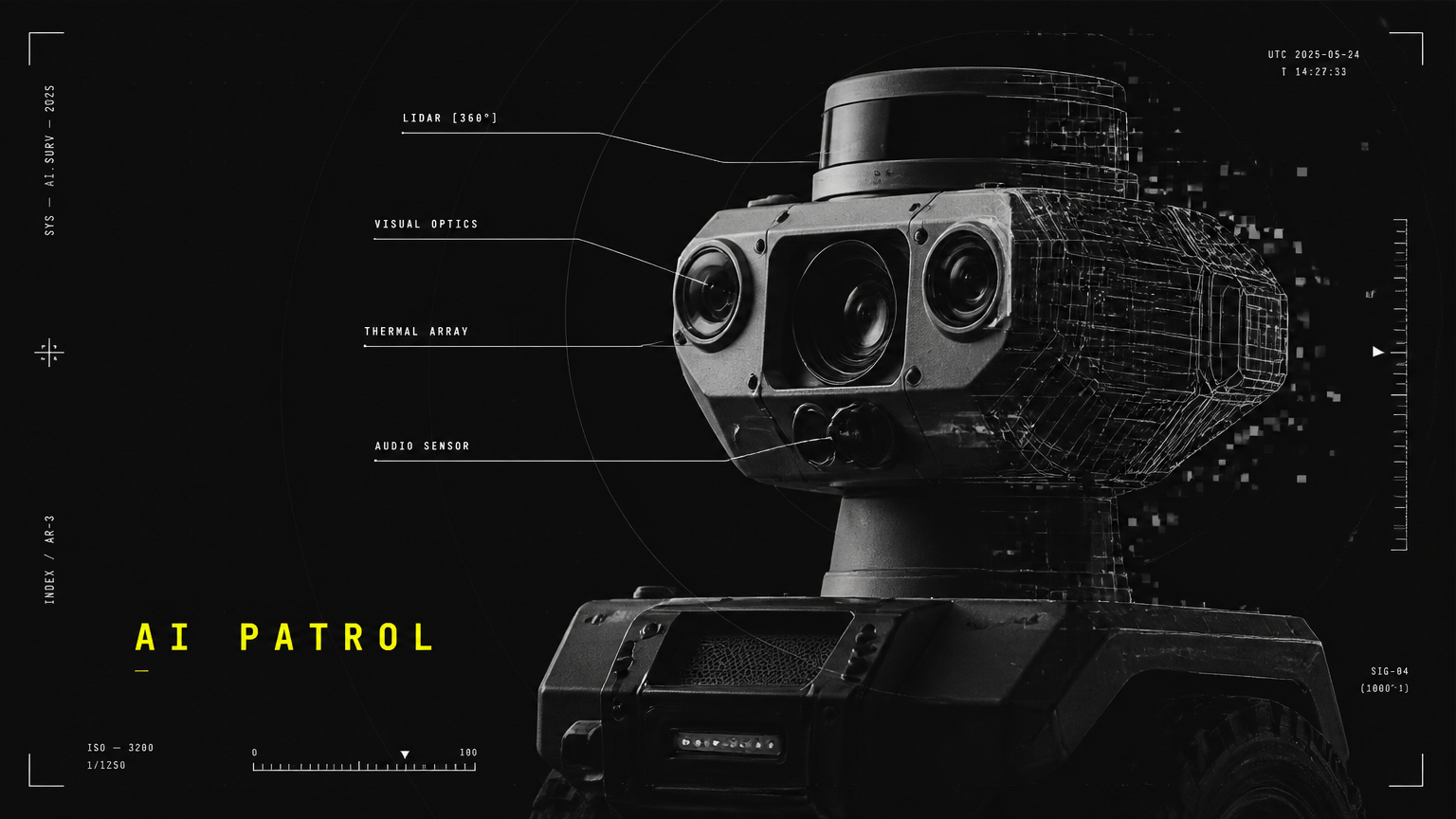
Quick answer: An AI surveillance robot combines LiDAR, visual, thermal and audio sensors with autonomous patrol logic to monitor campuses, facilities and public spaces 24/7 without fatigue. When it detects intrusions, anomalies or safety risks, it streams live evidence and triggers instant alerts to your security team via AI fleet-management software.
For facility heads, security managers, and operations leaders, the question is no longer whether automation belongs in physical security, but how do security robots work in real-world conditions — in rain, low light, crowded lobbies, and sprawling industrial yards. This guide breaks down the sensor stack, the autonomy behind patrols, and the alert workflow that makes an autonomous security robot a reliable extension of your team.
How Do Security Robots Work? The Core Sense-Decide-Act Loop
Every surveillance robot operates on a continuous sense-decide-act loop.
Sense: The robot collects data from multiple security robot sensors simultaneously — laser scans for distance, cameras for visual context, thermal imagers for heat signatures, microphones for audio events, and environmental sensors for smoke or gas.
Decide: Onboard AI and fleet software fuse those inputs, localize the robot on a facility map, identify people, vehicles and objects, and determine whether what it sees is normal or anomalous.
Act: If everything is normal, the autonomous patrol robot continues its route and logs evidence. If something is abnormal — a person in a restricted zone at 2 a.m., an overheated electrical panel, a fallen individual, an open gate — it records high-resolution video, tags the event, and escalates it instantly.
Unlike a fixed camera that only sees one angle, an AI security patrol robot moves to the point of interest, follows a planned route, avoids obstacles, and provides live, mobile eyes and ears across your entire site.
Inside an AI Surveillance Robot: Sensor Fusion Stack Explained
No single sensor can deliver reliable day-night detection on its own. An AI surveillance robot relies on sensor fusion — combining complementary sensors so weaknesses in one are covered by strengths in another.
LiDAR for Precision Mapping and Distance
LiDAR is the foundation of autonomy. It emits laser pulses and measures return time to build a precise 360-degree 3D point cloud of the surroundings.
In practice, LiDAR allows the autonomous security robot to measure distances to walls, fences, parked vehicles, and people with centimeter-level accuracy, navigate in complete darkness, and maintain safe clearance in narrow corridors, warehouses, and parking structures. It is what enables consistent patrols even when lighting fails or cameras are blinded by glare.
360-Degree Visual Cameras for Context and Evidence
High-resolution daylight cameras and 360-degree vision systems provide the visual detail security teams need: faces, uniforms, license plates, open doors, spillages, and safety violations.
Modern AI security patrol robots run onboard video analytics to classify people vs. vehicles vs. forklifts, detect loitering, trespassing in virtual zones, and crowd formation, and capture time-stamped clips for audit and investigation. PTZ (pan-tilt-zoom) capabilities allow the robot to zoom in on a distant anomaly without leaving its patrol path.
Thermal Imaging for Night and Low-Visibility Detection
Thermal cameras detect heat, not light. That makes them critical for 24/7 monitoring gaps — night shifts, unlit perimeters, basements, power rooms, and fog or smoke-filled areas.
A surveillance robot equipped with thermal imaging can spot human presence in darkness at long range, identify overheating machinery, electrical hotspots, or early fire risk, and distinguish live subjects from shadows or reflections that often trigger false alarms on standard CCTV.
Microphones and Audio Analytics
Audio is an underrated layer of security. Multi-microphone arrays enable the robot to detect glass breakage, raised voices, alarms, or vehicle sounds, support two-way communication for remote warnings — for example, “You are in a restricted area, please leave” — and allow control-room operators to listen in and speak through the robot during an incident.
Gas, Smoke, and Environmental Sensors
For industrial parks, hospitals, logistics hubs, and manufacturing plants, safety is as important as intrusion detection. Many autonomous patrol robots integrate gas, smoke, temperature, and humidity sensors to flag LPG, CO, or chemical leaks, monitor air quality in sensitive zones, and trigger safety alerts before a hazard escalates.
Obstacle, Cliff, and Collision Sensors
Ultrasonic sensors, depth cameras, bump sensors, and cliff sensors work with LiDAR to ensure safe navigation around people, pallets, glass doors, stairs, and curbs. This layered safety system is why autonomous patrol robots can operate safely in dense foot traffic at corporate campuses, malls, hospitals, and airports.
Together, this fusion stack gives facility teams reliable detection across day and night, indoors and outdoors, without adding more guard posts.
How an AI Surveillance Robot Patrols on Its Own
Autonomous patrol logic is what separates a true AI security patrol robot from a remote-controlled camera on wheels.
1. Digital Mapping and Route Planning
Deployment starts with mapping. The robot is driven or guided once through the facility to create a high-definition 2D/3D map — marking patrol routes, checkpoints, restricted zones, speed limits, and no-go areas.
Security managers can then define scheduled missions via fleet software: perimeter loops every 30 minutes, parking checks at night, lobby walkthroughs during peak hours, or random routes to avoid predictability. The autonomous patrol robot follows these missions automatically and adapts if a path is blocked.
2. Real-Time Localization and Obstacle Avoidance
Using SLAM (Simultaneous Localization and Mapping), the robot constantly compares live LiDAR and visual data to its map to know exactly where it is — to within centimeters.
If a delivery cart, crowd, or temporary barricade blocks the path, it slows down, reroutes, or waits safely, then resumes patrol without human intervention. Dynamic obstacle avoidance is essential for corporate parks, retail floors, hospitals, and transit hubs where environments change minute by minute.
3. People, Vehicle, and Anomaly Recognition
While patrolling, onboard AI continuously analyzes video and thermal feeds for:
- Unauthorized entry into geofenced zones
- Loitering beyond a time threshold
- Unknown vehicles in loading bays or VIP parking
- Fallen persons or unusual inactivity
- Left-behind objects or open gates and doors
- Deviations from normal patterns, such as activity in a zone that is typically empty at night
This anomaly recognition reduces dependence on operators staring at walls of monitors. Instead of watching everything, your team is directed only to verified events with context.
4. Continuous 24/7 Operation Without Fatigue
An autonomous security robot does not lose focus at hour 10 of a night shift. It patrols on schedule, docks automatically to recharge, and resumes missions on its own. With multi-robot coordination, one robot can charge while another covers the zone, enabling true round-the-clock coverage.
This is where engineering maturity matters. Allbotix systems are built in-house — design, firmware, and source code — and paired with proprietary AI fleet-management software with real-time monitoring and predictive maintenance. Across its portfolio, Allbotix has developed 525+ robots for 180+ clients with 99.8% uptime, backed by publicly listed Nanta Tech Limited. That precision engineering approach, supported by 24/7 Premium Support and Made-in-India manufacturing, is designed for continuous operation at enterprise scale.
How an AI Surveillance Robot Detects, Alerts, and Escalates
Detection without a clear response workflow creates noise. A mature alert pipeline turns sensor data into decisive action.
Real-Time Video Evidence, Not Just Alarms
When an event is triggered, the robot captures live video, thermal snapshots, location coordinates, and event type, and streams it to the security dashboard and mobile devices. Instead of a vague “Motion at Gate 3” alarm, operators see a 20-second clip of a person climbing a fence, with map location and patrol history.
This evidence-rich alerting helps control rooms verify threats in seconds, reduces false dispatches, and creates audit-ready records for compliance, insurance, and public-service transparency.
Escalation to Control Room and On-Ground Teams
A typical workflow for an autonomous security robot looks like this:
- Detect and classify: Robot identifies intrusion, safety hazard, or anomaly.
- Local deterrence: Spotlight, siren, or pre-recorded voice warning activates; two-way talk enables operator intervention.
- Instant notification: Alert with live stream pushed to control room, supervisor phone, and fleet dashboard.
- Human response: Nearest guard, facility team, or emergency service is dispatched with precise location and video context.
- Log and learn: Event is archived with metadata for reporting, pattern analysis, and route optimization.
Integration with Proprietary Fleet-Management Software
The real force multiplier is software. Allbotix pairs its hardware fleets — spanning receptionist, humanoid, quadruped/dog, cleaning, serving, AMR, and cobot form factors — with proprietary AI fleet management for live tracking, health monitoring, and predictive maintenance.
For security leaders, that means you can monitor multiple AI surveillance robots across buildings, campuses, or cities from one pane of glass, review patrol completion, battery status, and incident timelines, integrate alerts with existing VMS, access control, or PA systems, and scale from one pilot robot to a multi-site fleet without adding proportional headcount.
The result is not replacement of guards, but augmentation: robots handle repetitive, high-risk, and overnight patrols, while human officers focus on judgment, intervention, and visitor experience.
Where Autonomous Patrol Robots Deliver Value Across Facilities
Different environments have different monitoring gaps. Here is how facility leaders are applying autonomous patrol robots today:
Corporate IT campuses and office parks: Night perimeter patrols, parking enforcement, lobby and atrium checks during off-hours, reducing front-desk and guard overtime while maintaining dense foot-traffic safety.
Government and public services: 24/7 monitoring of public buildings, depots, and utilities under tight staffing budgets, with transparent video logs for accountability.
Education campuses: Sprawling universities and training centers use surveillance robots for hostel perimeters, parking lots, and late-night pathways where thin support staff cannot be everywhere.
Healthcare: Hospitals deploy patrols for parking structures, emergency entries, and non-clinical corridors to reduce round-the-clock strain on staff while supporting infection-control protocols through contactless monitoring.
Retail malls and large-format stores: After-hours intrusion checks, back-of-house and loading dock monitoring, and daytime brand-differentiating presence that complements greeters and cleaning automation.
Manufacturing, logistics, and airports: Industrial parks, 3PL warehouses, and transit hubs use AI security patrol robots for fence-line checks, dock-door status, hazardous-zone monitoring, and high-density public-area deterrence.
Autonomous Security Robot vs Manual Patrols vs Static CCTV
Facility leaders often ask where robots fit alongside existing measures. Each layer has a role, but mobile autonomy closes specific gaps:
| Criterion | Manual Guard Patrols | Static CCTV System | Autonomous Security Robot |
|---|---|---|---|
| Coverage area | Limited to one location at a time, foot-speed | Fixed field of view, blind spots between cameras | Mobile, covers large perimeters, parking, and multi-building routes |
| 24/7 consistency | Fatigue, shift gaps, high overtime cost | Always on, but needs human to watch feeds | Patrols 24/7 without fatigue, auto-recharge and resume |
| Detection intelligence | Strong judgment, variable alertness | Basic motion detection, high false alarms | AI fusion of LiDAR, video, thermal, audio for verified alerts |
| Evidence quality | Verbal reports, bodycam dependent | Fixed-angle clips, no mobility to investigate | Live mobile video + thermal + location with incident timeline |
| Deterrence | High human presence, limited scale | Passive, often noticed only after incident | Active deterrence with lights, audio warnings, and movement |
| Scalability and cost | Cost rises linearly with headcount | High cabling/install cost to expand coverage | Scales via software-defined routes, one dashboard for fleet |
| Integration | Radio/phone coordination | VMS/NVR based | Fleet-management software, VMS/access control integration, predictive maintenance |
The most resilient security posture combines all three: CCTV for fixed chokepoints, guards for intervention and service, and autonomous security robots for persistent, mobile coverage.
What to Look for When Evaluating an Autonomous Security Robot
Before piloting, operations leaders should validate:
- True autonomy: Can it map, reroute, avoid crowds, and auto-dock without constant supervision?
- Sensor depth: Does it combine LiDAR, 360 vision, thermal, audio, and environmental sensing for day-night reliability?
- Alert quality: Do you get live video with location and classification, or just motion pings?
- Software ownership: Is fleet management proprietary with real-time monitoring and predictive maintenance, or a third-party add-on?
- Engineering and support: Is the platform engineered in-house for your precision, ambition, and scale, with 24/7 support and proven uptime?
- Versatility: Can the same partner support adjacent needs — AI receptionists for visitor management, cleaning automation, AMRs for material movement — to unify operations?
Allbotix is built around this breadth. Rather than a single-vertical vendor, it engineers a multi-vertical fleet with full IP ownership of design, firmware, source code, and trademarks, scaled via its Aimtron Technologies manufacturing partnership. That limitless innovation model allows corporate, government, education, healthcare, retail, and industrial sites to start with surveillance and expand into complementary automation under one ecosystem.
Bring 24/7 Autonomous Coverage to Your Facility with Allbotix
An AI surveillance robot is not science fiction — it is a practical answer to 24/7 monitoring gaps, guard shortages, and rising expectations for safety and transparency. By fusing LiDAR, visual, thermal, audio, and environmental sensing with autonomous patrol logic and instant, evidence-rich alerts, it gives your security team continuous visibility without continuous headcount.
If you manage a campus, hospital, mall, plant, warehouse, or transit facility and need reliable night coverage, perimeter discipline, and faster incident response, Allbotix can help you design a pilot route, integrate with your control room, and scale across sites.
Talk to Allbotix at https://www.allbotix.ai to see how an AI surveillance robot and proprietary fleet-management software can strengthen your security operations — with precision engineering, 99.8% uptime, and 24/7 Premium Support.