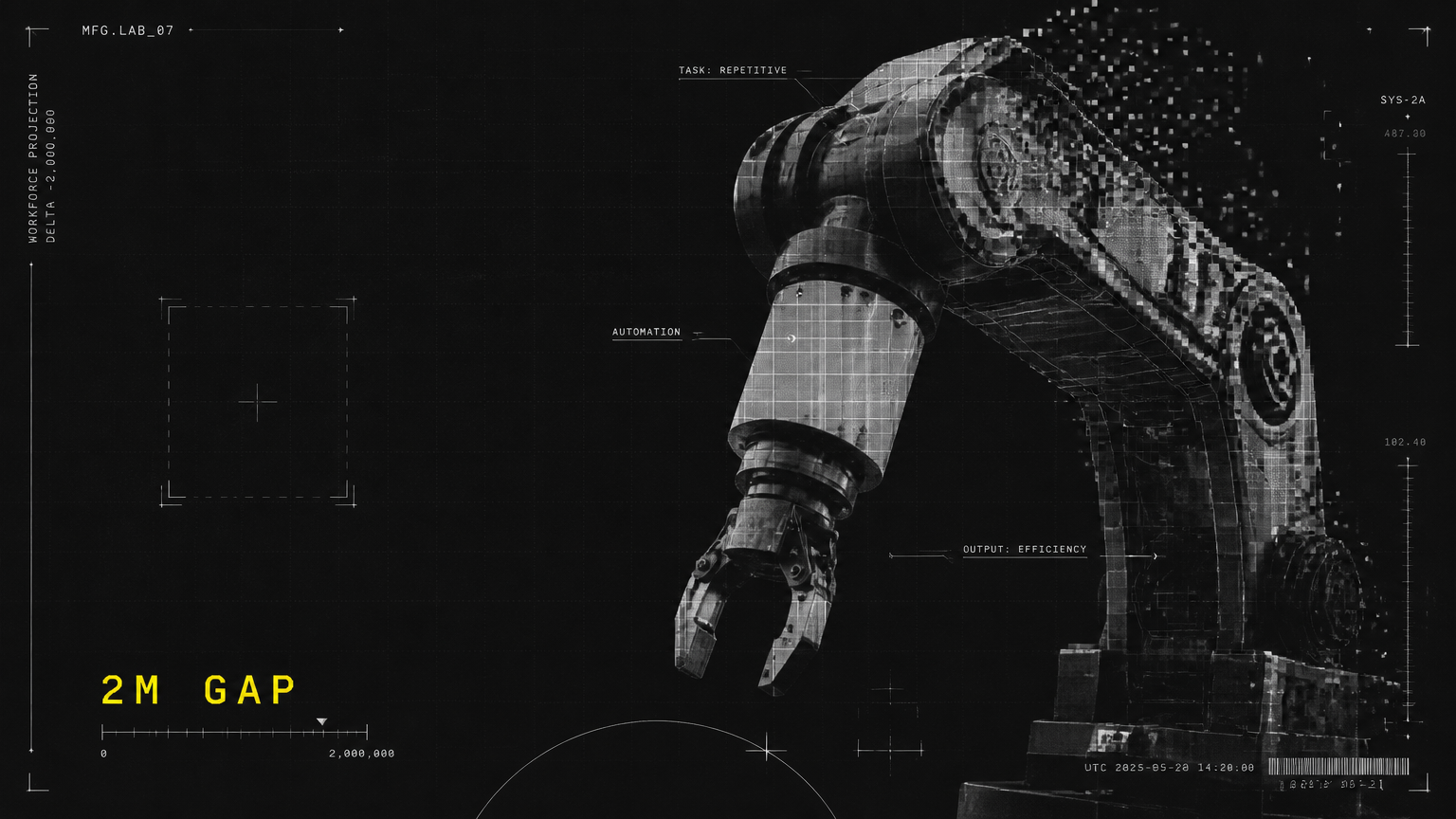
Robots are increasingly filling the projected 2 million worker shortfall in manufacturing by automating repetitive tasks, improving efficiency, and allowing human workers to focus on higher-value activities. This integration helps mitigate labor shortages, boosts productivity, and ensures operational continuity in the sector.
The manufacturing industry, a cornerstone of global economies, is grappling with an unprecedented challenge: a severe labor shortage. Projections from leading industry reports, including those by Deloitte and the Manufacturing Institute, indicate a staggering shortfall of over 2 million workers in the next decade. This isn't merely a statistic; it represents a critical threat to production capacity, innovation, and economic stability. From industrial parks to sprawling production plants, the inability to find and retain skilled labor is leading to production delays, increased operational costs, and missed market opportunities.
This crisis isn't confined to a single role or region; it's a systemic issue affecting various aspects of manufacturing, from assembly lines to quality control and logistics. The aging workforce, a lack of interest from younger generations in traditional manufacturing roles, and the demand for new skills in an increasingly digital landscape all contribute to this widening gap. The impact is profound: operational downtime, reduced throughput, and a struggle to maintain the competitive edge.
Quantifying the Manufacturing Labor Shortage and Its Impact
The 2 million worker shortfall isn't just a number; it's a chasm that threatens to swallow the industry's growth potential. This deficit translates directly into tangible problems for manufacturers:
- Production Inefficiency: Fewer hands mean slower production lines, reduced output, and an inability to meet demand. This directly impacts revenue and market share.
- Increased Costs: Overtime for existing staff, recruitment expenses, and the cost of lost production add up, eroding profit margins.
- Quality Control Challenges: A stressed, understaffed workforce can lead to errors, increased scrap rates, and inconsistent product quality, damaging brand reputation.
- Delayed Innovation: With resources stretched thin, companies struggle to invest in R&D or implement new technologies that could drive future growth.
- Operational Downtime: A lack of personnel for maintenance or unexpected issues can lead to significant and costly stoppages.
The urgency for manufacturing labor gap solutions has never been higher. Businesses are actively seeking innovative strategies to maintain productivity, ensure quality, and sustain growth in the face of this persistent challenge.
Robotics in Manufacturing Workforce: Specific Ways Robots Are Bridging the Gap
The integration of robotics is emerging as a powerful antidote to the manufacturing labor crisis. Far from replacing human workers entirely, robots are being strategically deployed to augment human capabilities, automate strenuous or repetitive tasks, and fill critical labor gaps. Allbotix, with its broad, multi-vertical fleet of service and industrial robots, is at the forefront of this transformation, offering precision-engineered solutions tailored to the diverse needs of the manufacturing sector.
Autonomous Mobile Robots (AMRs) for Logistics and Material Handling
In a manufacturing environment, the movement of materials, components, and finished goods is constant. This often involves repetitive, physically demanding, and time-consuming tasks. AMRs are revolutionizing this aspect:
- Filling Internal Logistics Gaps: AMRs can autonomously transport materials between workstations, warehouses, and assembly lines, reducing the need for human forklift operators or manual transporters. This directly addresses labor shortages in internal logistics.
- Improving Efficiency and Throughput: By operating continuously and optimizing routes, AMRs significantly increase the speed and efficiency of material flow, contributing to 15-30% throughput increases.
- Enhanced Safety: Removing humans from repetitive material handling tasks reduces workplace accidents and injuries.
Allbotix's AMRs are designed with proprietary AI fleet-management software, ensuring seamless integration and optimal performance within complex factory layouts.
Collaborative Robots (Cobots) for Enhanced Human-Robot Collaboration
Cobots are designed to work safely alongside human employees, making them ideal for tasks that require both robotic precision and human dexterity or decision-making.
- Augmenting Assembly Lines: Cobots can perform repetitive assembly tasks, pick-and-place operations, or quality checks, freeing human workers to focus on more complex, intricate, or cognitive tasks.
- Addressing Skill Gaps: In areas where specific manual skills are scarce, cobots can take over, ensuring consistent quality and output.
- Increased Capacity: By sharing workspaces and collaborating on tasks, cobots can boost overall production capacity by 20-40%, mitigating the impact of fewer available human workers.
Allbotix's cobots are engineered for precision and adaptability, offering "limitless innovation" in how human and robot teams can collaborate.
Humanoid Robots for Training and Assistance
While less common on the direct production line, humanoid robots offer unique capabilities for the future of manufacturing jobs robots.
- Training and Instruction: Humanoid robots can be programmed to demonstrate complex assembly procedures or safety protocols, offering consistent and repeatable training for new hires or upskilling existing staff. This can be particularly valuable in environments with high turnover or specialized equipment.
- Factory Assistance: In some scenarios, humanoids can assist with tasks like tool retrieval, inventory checks, or even basic quality inspections, further reducing the burden on human workers.
Allbotix's diverse fleet, including humanoid form factors, showcases its commitment to exploring the full spectrum of robotic applications, even for emerging needs like advanced training and assistance.
The ROI and Operational Benefits of Integrating Robotics
The decision to integrate robotics to address labor challenges isn't just about filling gaps; it's a strategic investment that yields significant ROI and operational benefits.
Reduced Downtime and Enhanced Reliability
One of the most critical issues in manufacturing is unplanned downtime. Labor shortages exacerbate this, as fewer personnel are available for maintenance or quick problem resolution.
- Predictive Maintenance: Allbotix's proprietary AI fleet-management software, built in-house, offers real-time monitoring and predictive maintenance capabilities. This means potential issues are identified before they lead to breakdowns, cutting unplanned downtime by 30-50%. Documented cases show 26%+ reductions and ~$630K in annual savings per plant.
- 24/7 Operation: Robots don't require breaks, sleep, or sick days. They can operate continuously, ensuring production continuity even when human staff are unavailable. This is particularly beneficial for manufacturing plants operating round-the-clock shifts.
Improved Quality and Consistency
Human error is a natural part of any manual process. Robots, however, offer unparalleled precision and repeatability.
- Automated Quality Control: Robots equipped with vision systems can perform consistent quality checks, identifying defects that might be missed by the human eye. This reduces scrap rates by 20-50%.
- Standardized Processes: By performing tasks identically every time, robots ensure a consistent product, leading to higher customer satisfaction and fewer costly recalls.
Rapid Return on Investment (ROI)
The initial investment in robotics might seem substantial, but the payback period has drastically shortened.
- Accelerated Payback: The average robot payback time has dropped from approximately 5.3 years in 2019 to around 1.3 years in 2024.
- Significant ROI: Well-run deployments often see a 10:1 to 30:1 ROI within 18 months, driven by increased throughput, reduced labor costs, and improved quality.
Comparison of Traditional vs. Robotic Manufacturing Workforce
To illustrate the stark differences and advantages, consider a comparison:
| Feature/Criterion | Traditional Manufacturing Workforce (Labor Shortage Context) | Robotic Manufacturing Workforce (Integrated) |
|---|---|---|
| Availability | Scarce, inconsistent, prone to absenteeism, high turnover | 24/7, consistent, high uptime (99.8% with Allbotix) |
| Task Performance | Prone to fatigue, variable speed/quality, best for complex problem-solving | Repetitive, precise, high-speed, consistent quality, best for dull, dirty, dangerous tasks |
| Operational Costs | High and rising labor costs, overtime, recruitment, training, benefits | Initial capital investment, lower ongoing operational costs, energy, maintenance, rapid ROI |
| Scalability | Limited by labor pool availability, slow to scale up | Highly scalable, can quickly add or reconfigure robots to meet demand fluctuations |
| Safety | Risk of human error, accidents, injuries in hazardous environments | Reduced human exposure to hazards, enhanced workplace safety |
| Data & Analytics | Manual data collection, subjective performance metrics | Real-time data collection, predictive analytics, objective performance monitoring (Allbotix software) |
| Quality Control | Subject to human fatigue and oversight, variable consistency | Automated, highly consistent, precise defect detection, reduced scrap rates |
| Downtime | Can be high due to labor shortages, human error, maintenance delays | Minimized by predictive maintenance, continuous operation, rapid issue resolution |
| Focus of Human Workers | Often stuck on repetitive, low-value tasks due to shortages | Shifted to higher-value activities: supervision, innovation, complex problem-solving, strategic planning |
This comparison clearly highlights how automation addressing labor shortage is not just a stopgap measure but a fundamental shift towards a more resilient, efficient, and productive manufacturing future.
Allbotix: Engineering Solutions for the Industrial Robots Labor Crisis
At Allbotix, we understand the critical challenges facing the manufacturing sector. Our approach goes beyond simply providing robots; we engineer comprehensive solutions. With over 525 robots developed and 180+ happy clients, our commitment to "precision engineering" and "limitless innovation" is evident in every deployment.
Unlike companies that assemble off-the-shelf components, Allbotix boasts full IP ownership of our designs, firmware, and source code. This in-house engineering, backed by publicly listed Nanta Tech Limited and scaled through our Made-in-India manufacturing via Aimtron Technologies partnership, allows us to create machines perfectly tailored to a client's specific precision, ambition, and scale.
Our diverse fleet, spanning AMRs, cobots, and even humanoid robots, combined with our proprietary AI fleet-management software, offers a robust framework for manufacturers across various segments, including:
- Manufacturing & Production: Addressing production inefficiency, workforce shortages, and costly downtime directly.
- Logistics & Warehousing: Optimizing inventory movement, enhancing fleet visibility, and streamlining pallet transport.
We provide 24/7 Premium Support, ensuring that our robotic solutions deliver 99.8% uptime, a testament to our reliability and dedication to operational continuity. By integrating Allbotix's advanced robotics, manufacturers can not only overcome the current labor crisis but also position themselves for sustained growth and innovation in the decades to come.
The industrial robots labor crisis demands a proactive and technologically advanced response. Allbotix provides that response, transforming manufacturing operations and securing a productive future.
Ready to bridge your manufacturing labor gap with advanced robotics? Discover how Allbotix's precision-engineered solutions can optimize your operations and secure your future. Visit https://www.allbotix.ai/ to learn more.