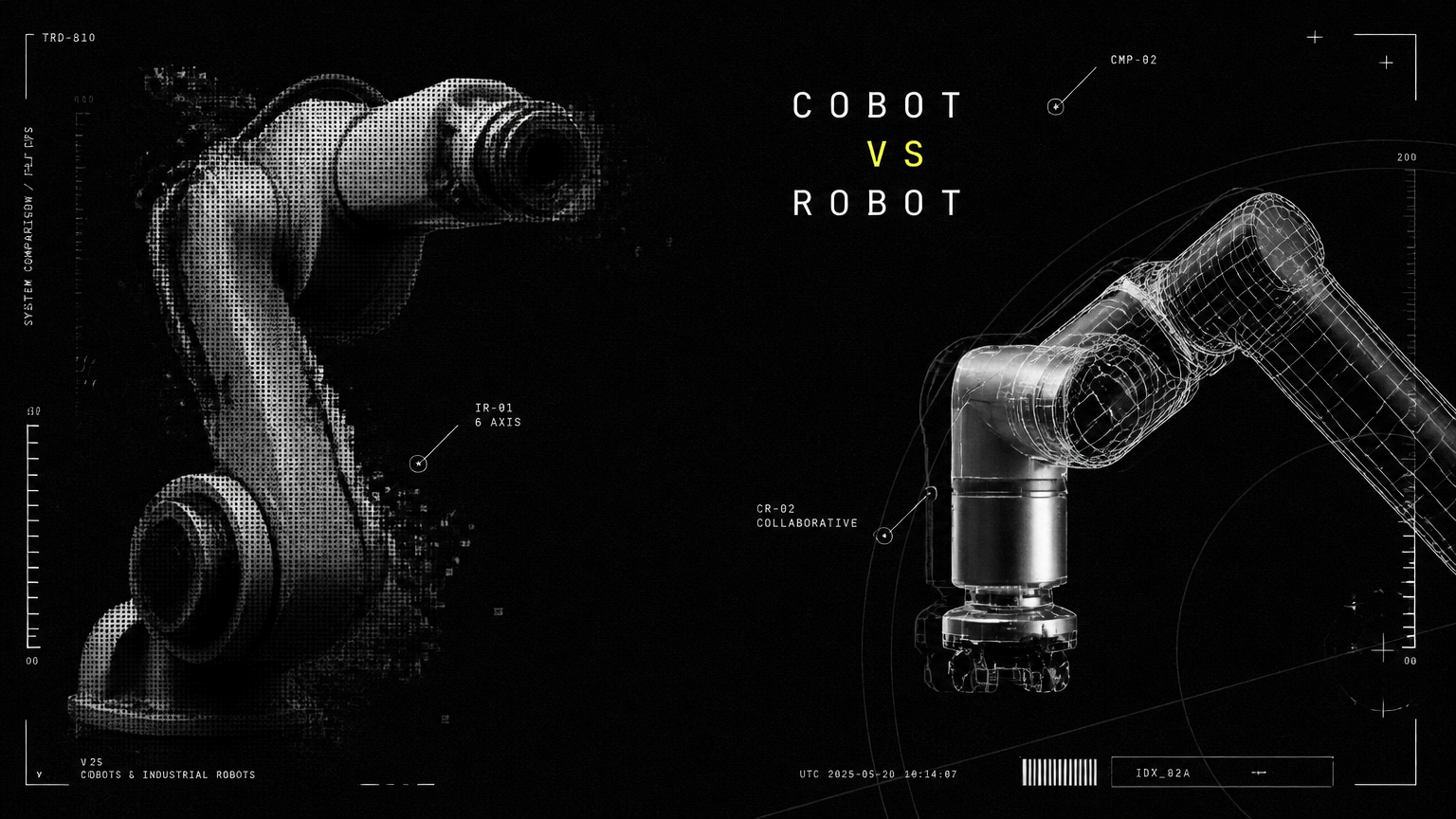
Cobot vs industrial robot: cobots (collaborative robots) are built for safe, flexible, human-shared workspaces with faster deployment, lower upfront cost and easier reprogramming; industrial robots deliver higher payloads, speed and precision for continuous, heavy-duty production. Plant managers should choose cobots where variability, human interaction and quick ROI matter, industrial robots where throughput, heavy payloads and cycle-time optimization are critical — or combine both in a managed fleet to maximize uptime and ROI.
Part of our guide to Definitions & Comparisons: What Is an Autonomous Mobile Robot (AMR)? Definition, Types and Use Cases.
Cobot vs Industrial Robot: A Side-by-Side Comparison for Plant Managers
As a plant manager evaluating automation, you need clear, actionable comparisons between collaborative robot vs industrial robot options. Below you’ll find direct, operationally focused side-by-side tables covering capability, cost and ROI, safety, deployment and lifecycle — plus guidance on when to choose one, the other, or a mixed-fleet strategy. Allbotix brings real-world deployments, proprietary fleet-management software and 525+ in-house engineered robots to help execute these strategies with 99.8% uptime and 24/7 Premium Support.
Cobot vs industrial robot — Capability & use-case fit
| Criterion | Cobot (Collaborative Robot) | Industrial Robot |
|---|---|---|
| Typical payload range | 0.5 kg – 20 kg (light to medium payloads) | 10 kg – 500+ kg (light to heavy payloads) |
| Cycle speed / raw throughput | Moderate — optimized for tasks with human interaction; cycle times longer than top-end industrial arms | High — fastest cycle times for continuous, high-throughput production |
| Repeatability (typical) | ±0.02 mm – ±0.1 mm (good for most assembly/inspection) | ±0.01 mm – ±0.05 mm (higher precision for tight-tolerance machining/welding) |
| Typical tasks | Pick-and-place, machine tending, light assembly, screw-driving, inspection, collaborative packing | High-speed pick-and-place, palletizing, arc welding, heavy material handling, press tending |
| Typical best-fit environments | Benchtop lines, human-shared cells, flexible production, small-batch runs | High-volume lines, welding booths, heavy-material handling zones, long unstaffed runs |
| Reprogramming & task switching | Easy, often GUI / hand-guiding; minimal downtime for changeovers | Requires offline programming/integration expertise; longer retooling time |
| Safety approach | Force-limited design, speed-and-separation or power & force limiting for safe human interaction | Safety via physical guarding, light curtains, fencing, interlocks; no intentional human contact |
When to choose a cobot
- Tasks that require humans and robots to work side-by-side (assembly, inspection, kitting).
- Environments with frequent changeovers, small batches, or variable SKUs.
- Where fast redeployment and operator-driven programming reduce downtime.
When to choose an industrial robot
- High-volume, continuous tasks where cycle-time wins the day (palletizing, welding).
- Heavy payloads and operations requiring the highest repeatability and rigid fixtures.
- Fully guarded cells where production speed and throughput maximization are the priority.
Cobot vs industrial robot — Total cost of ownership & ROI
| Cost / ROI Criterion | Cobot | Industrial Robot |
|---|---|---|
| Typical purchase price (robot only) | Lower upfront capital (entry models significantly cheaper) | Higher upfront capital, range increases with payload and axis count |
| Integration & tooling cost | Lower — simpler guards, lighter tooling; faster integration | Higher — fixtures, guarding, robust end-effectors, system PLCs |
| Cell footprint & infrastructure | Smaller footprint; often no heavy foundation | Larger footprint; sometimes requires foundations, reinforced mounts |
| Energy consumption | Lower per-cycle energy usage for light tasks | Higher energy draw for high-speed/heavy tasks |
| Labor impact | Reduces repetitive tasks; enables upskilling staff | Replaces high-volume manual labor; may reduce headcount in high-throughput stations |
| Typical payback timeline | 6–18 months for well-targeted use cases | 12–36 months depending on scale and utilization |
| Example ROI drivers | Faster redeployment, fewer staffing gaps, quick productivity gains on variable lines | High throughput, reduced cycle times, lower scrap on precision tasks |
How to evaluate TCO and payback
- Include integration, fixturing, safety engineering, and staff training in your budget.
- Account for downtime: Allbotix deployments report real-world reductions in unplanned downtime through predictive maintenance and an average ROI improvement—well-engineered cobot pilots often pay back within 12–18 months; industrial lines optimized end-to-end can deliver multi-year ROI with larger absolute gains.
- Consider utilization: An industrial robot running 24/7 will amortize cost faster than a cobot used intermittently.
Cobot vs industrial robot — Deployment, safety & lifecycle
| Lifecycle & Safety Criterion | Cobot | Industrial Robot |
|---|---|---|
| Typical deployment time | Days to weeks (including programming & training) | Weeks to months (integration, safety cell design, PLC integration) |
| Programming complexity | Low — teach-by-hand, graphical tools, quick operator retraining | High — offline programming, motion planning, integrate with SCADA/PLCs |
| Safety systems | Built-in force-limiting; often permits shared workspace; risk assessments still required | External guarding, interlocks, light curtains; strict access control and safety engineering |
| Maintenance frequency | Lower mechanical stress for light tasks; periodic firmware & preventive maintenance | Higher for heavy-duty continuous use; requires scheduled mechanical and electrical maintenance |
| Predictive maintenance & fleet management | Readily integrated with cloud telemetry & predictive alerts | Integrates with enterprise maintenance but may need customization for telemetry |
| Typical uptime | High for targeted tasks; uptime improves with centralized fleet management | Very high when correctly engineered; continuous operation requires robust maintenance protocols |
Safety differences are real and material
- Cobot safety is engineered for human proximity using force-limited actuators and built-in sensors; this reduces need for full fencing in many applications but still requires risk assessment and workplace controls.
- Industrial robots assume separation: physical barriers, safety PLCs and stricter lock-out procedures are standard.
Allbotix advantage: centralized fleet-management and predictive maintenance
- Allbotix couples hardware with proprietary AI fleet-management software, enabling real-time monitoring and predictive maintenance. This approach supports faster mean-time-to-repair and contributes to our reported 99.8% uptime across deployments. For plant managers, that translates to fewer surprises and clearer ROI.
Throughput, precision and mixed-fleet strategies
| Performance / Strategy | Cobot-only | Industrial-only | Mixed fleet (Cobot + Industrial) |
|---|---|---|---|
| Peak throughput potential | Moderate | Very high | Optimized — heavy lifting done by industrial robots; flexible tasks by cobots |
| Best for variability | High — adaptable to product mix and changeovers | Low — optimized for consistent, stable products | High — combine speed where needed and flexibility elsewhere |
| Cost efficiency at scale | Lower for very high-volume operations | Higher at scale (per-unit cost advantages) | Balanced — capital efficiency plus flexibility |
| Deployment agility | Fast redeployments across cells | Slow redeployments | Strategic placement yields best overall utilization |
| Operational complexity | Lower | Higher | Higher (needs orchestration & fleet management) |
| Ideal use-case example | Labelling, inspection across SKUs | High-volume welding, palletizing | Machine tending (industrial arm) + quality inspection/kitting (cobot) |
When a mixed fleet makes sense
- Combine industrial robots for heavy, high-speed operations and cobots for peripheral tasks, inspection, quality, kitting and human-robot collaboration.
- Use fleet-management software to orchestrate maintenance windows, monitor utilization, and reassign cobots quickly as demand shifts.
Cobot use cases in factories (practical examples)
- Kitting and assembly assistance on mixed-SKU lines — cobots reduce operator reach time and improve ergonomics while enabling fast changeovers.
- Machine tending for small-to-medium parts — cobots load/unload CNC or injection-molding machines with quick reprogramming between batches.
- Visual inspection and sorting — integrate cameras and AI at the cobot wrist for inline QC without disrupting human workflows.
- Screw-driving and precision insertions — cobots are ideal where force control and safety are required near operators.
These cobot use cases in factories deliver measurable reductions in scrap and ergonomic-related absenteeism while preserving workforce flexibility.
Deployment checklist for plant managers
Before selecting cobot or industrial robot, confirm:
- Clear task definition (payload, cycle time, repeatability requirement).
- Expected utilization and production horizon (short-term pilot vs long-term line).
- Safety plan and whether shared workspace is required.
- Integration needs with PLC, MES, and ERP systems.
- Maintenance capabilities and whether centralized predictive maintenance is available.
How Allbotix supports plant-scale deployments
Allbotix engineers full-stack robotic solutions — from hardware designed in-house to fleet-management software that provides predictive maintenance and real-time telemetry. Key attributes relevant to plant managers:
- End-to-end engineering: 525+ robots developed in-house with IP ownership and Made-in-India manufacturing.
- Proven reliability: deployed across 180+ clients and delivering 99.8% uptime through active fleet monitoring.
- Cross-vertical experience: solutions for manufacturing, logistics, hospitality, healthcare and public services — enabling reuse of learnings across domains.
- 24/7 Premium Support and partnership-led deployment models that reduce integration risk and speed pilots.
- Precision engineering and “limitless innovation” approach to tailor machines to your production tolerance and scale.
If you’re balancing tight staffing budgets, high variability in product mix, or the need to increase throughput while preserving safety, Allbotix’s mixed-fleet, software-driven approach helps plant managers realize faster ROI and higher overall equipment effectiveness.
Recommendation matrix: which option suits which production task?
| Production Task | Best fit | Why |
|---|---|---|
| High-volume palletizing | Industrial Robot | Requires high payloads and continuous, fast cycles |
| Bench-level assembly with human workers | Cobot | Works safely alongside operators, easy reprogramming |
| Machine tending across small batches | Cobot (or mixed) | Fast changeovers and minimized downtime |
| Arc welding & heavy fabrication | Industrial Robot | High repeatability and weld quality at speed |
| Inline inspection with variable SKUs | Cobot | Easy to retool, integrates cameras and AI |
| Warehouse pick-and-place at scale | Industrial Robot / AMR-integrated solution | High speed and payload integration for heavy throughput |
| Quality sampling + operator assist | Mixed fleet | Cobots assist operators; industrial robots maintain throughput |
Final decision framework
- Prioritize industrial robots for tasks where cycle time, payload and continuous operation dominate business value.
- Prioritize cobots when flexibility, safety near humans, and fast redeployment drive ROI.
- Consider a mixed fleet when you need both — and use a centralized fleet-management platform to orchestrate maintenance, utilization and reassignment.
Next steps & CTA
If you’re evaluating a pilot or a fleet rollout, Allbotix can help assess your shop-floor tasks, run a focused pilot (cobot, industrial, or mixed), and provide a deployment plan that includes integration, predictive maintenance and support. Contact Allbotix to schedule a site assessment and pilot proposal — leverage our precision engineering, in-house IP and AI fleet-management to accelerate ROI and maximize uptime. Limitless innovation; precision engineering.