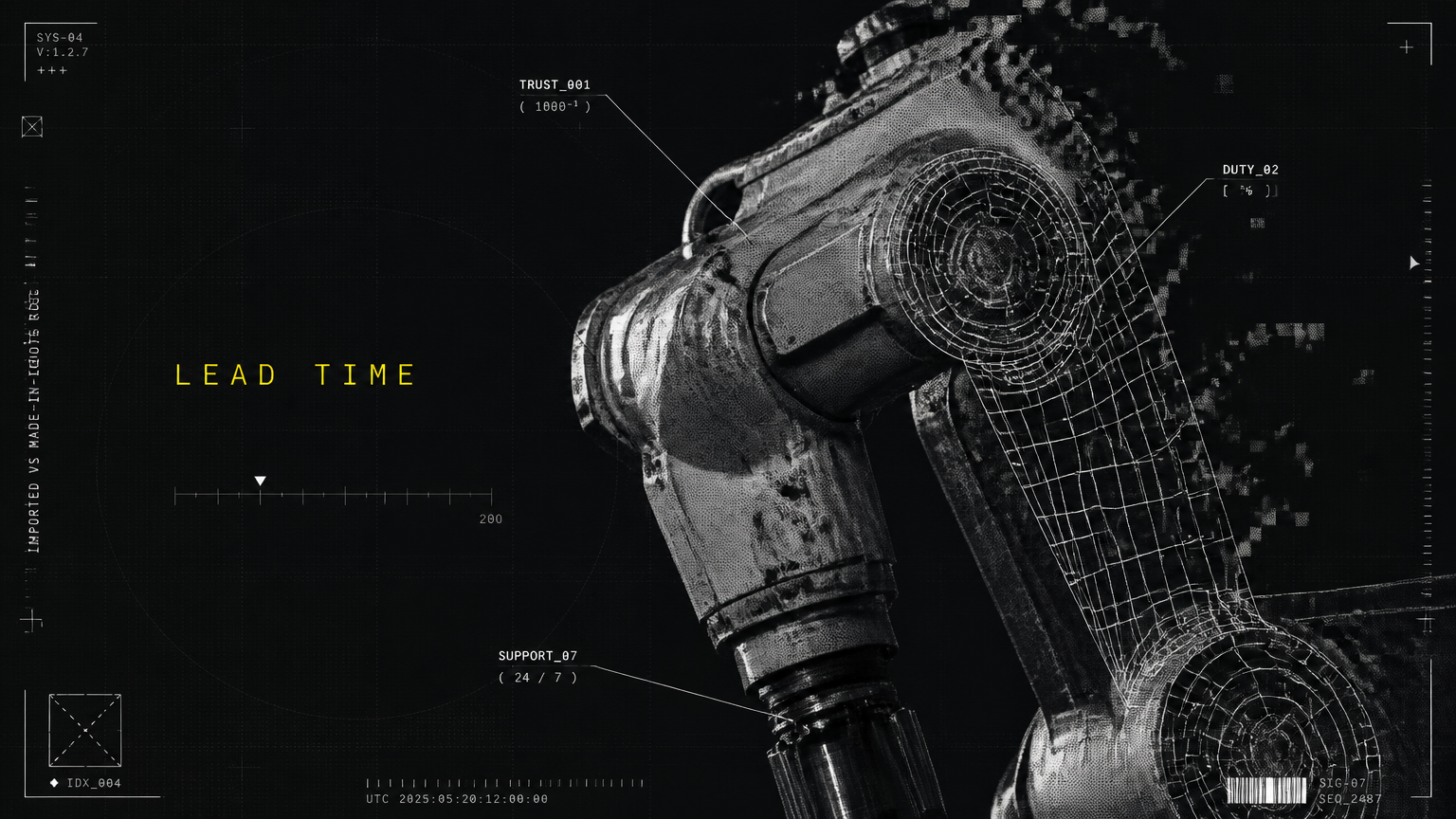
Imported robots often mean longer lead times, higher landed cost (shipping, customs and duties), and slower spare-part turnaround and on-site fixes; made-in-India robots usually shorten procurement-to-deployment time, simplify spares logistics and enable faster local support and customization. Choose local suppliers when rapid deployment, fast SLA-driven support, and predictable spare availability matter; imported systems can make sense only if they provide a unique capability not available domestically or a demonstrably superior global support network.
Part of our guide to Finance, Duty & Policy: GST, Import Duty and Depreciation on Robots: A Finance Team's Guide.
Imported vs Made-in-India Robots: Lead Times, Spares, Duty and Support
Imported vs made in india robots is a decision many procurement teams face today — especially in India’s corporate campuses, government facilities, retail malls, hospitals, manufacturing floors, logistics hubs and airports. This article lays out the practical differences across lead time, spare parts availability, import duty, support SLAs and total cost of ownership so you can choose the right path for your operational needs and risk tolerance.
Imported vs Made-in-India Robots: Lead Times & Procurement Risk
Short answer first: importing introduces shipping time, customs clearance and international production queues; domestic manufacturing compresses procurement-to-deploy and reduces supply-chain unpredictability.
Below is a focused comparison between imported robots and made-in-India robots on lead-time and procurement risk factors:
| Criterion | Imported Robots | Made-in-India Robots |
|---|---|---|
| Typical procurement lead time (order → on-site) | Often 3–6 months or longer (production queue + shipping + customs) | Typically 4–12 weeks (local production, faster QA and commissioning) |
| Shipping & logistics exposure | High: ocean/air freight, schedule variability, consolidation delays | Low: domestic transport, fewer handoffs |
| Customs & clearance risk | Moderate–High: documentation, inspections, quarantine, duty reassessments | Minimal: no import formalities |
| Vendor production queue & allocations | Susceptible to global demand spikes and factory backlogs | Easier to prioritize local builds and customizations |
| Flexibility for last-mile customization | Limited: changes may require rework and cross-border engineering cycles | High: onshore engineering, faster iterations |
| Procurement risk profile | Higher chance of schedule slips and surprise costs | Lower and more predictable time-to-deploy |
How this translates for your organisation: if you need a fast deployment for seasonal retail, a campus pilot, or a timed government program, locally manufactured robots significantly reduce the calendar and logistical risk. For longer strategic rollouts with large budgets, imported systems can work if you can tolerate schedule variability.
Lead time for AMRs imported vs Indian
If your decision centers on Autonomous Mobile Robots (AMRs), lead times can be critical. Here’s a targeted comparison for AMRs (mobile robotics fleet deployments):
| Criterion | Imported AMRs | Made-in-India AMRs |
|---|---|---|
| Typical pilot-to-fleet lead time | 3–6 months (hardware delivery + integration) | 6–12 weeks (local tuning, on-site validation) |
| Fleet scaling speed | Slower — each tranche may face new shipping windows | Faster — local production scales tranches quickly |
| Software & fleet-management integration | Often needs remote coordination with OEM’s cloud teams | Quicker local integration, especially with onshore fleet-management teams |
| Spare and replacement unit availability | Replacement units may require weeks | Rapid local swaps or on-site repairs (same-day to a week) |
If you need to scale an AMR fleet rapidly, the lead time advantage of made-in-India suppliers typically dominates.
Imported vs Made-in-India Robots: Spares, Serviceability & Support
Spare-part availability and field support determine uptime and operational risk. Allbotix’s model — in-house engineered hardware plus proprietary AI fleet-management software — demonstrates how a local approach can improve availability and mean-time-to-repair.
| Criterion | Imported Robots | Made-in-India Robots |
|---|---|---|
| Spare parts availability | Often limited locally; replacement parts shipped from overseas (weeks) | Higher local inventory, quicker fulfilment (same-day to a few days) |
| On-site field service / SLAs | Dependent on regional partners or OEM travel; longer response windows | Direct local field teams with 24/7 escalation; faster on-site fixes |
| Predictive maintenance & remote diagnostics | Possible but may require OEM cloud access & latency for parts | Local fleet-management + predictive maintenance enables quicker interventions |
| Warranty handling | International warranty claims can be slow; cross-border logistics | Faster local warranty adjudication and replacement |
| Spare-part cost & inventory management | Higher carrying cost due to minimum order quantities & shipping | Optimised local stocking, lower shipping premiums, lower lead-time risk |
| Impact on uptime | Greater risk of prolonged downtime | Lower risk; faster mean time to repair contributes to higher uptime |
Allbotix specific advantage: Allbotix’s in-house engineering, proprietary AI fleet-management and a 24/7 Premium Support network support 99.8% realized uptime across 525+ robots deployed to 180+ clients. Building and stocking critical spares domestically shortens MTTR and protects operations in time-sensitive environments like hospitals, airports and logistics centers.
Imported vs Made-in-India Robots: Duties, Taxes & Total Cost of Ownership
Landed cost is more than invoice price. Duties, GST/IGST, logistics, insurance and opportunity cost from deployment delays all affect total cost of ownership (TCO).
| Cost Component | Imported Robots | Made-in-India Robots |
|---|---|---|
| Base unit price | Can be competitive depending on OEM scale | Competitive, plus potential local customization value |
| Import duty & customs charges | Additional; varies by HS code and classification; can materially increase landed cost | No import duty or clearance fees |
| GST / IGST & compliance | IGST + CVD/cess may apply depending on classification | GST applicable only on domestic supply; generally simpler compliance |
| International shipping & insurance | High for heavy/technical units; variable | Lower domestic logistics costs |
| Inventory carrying & spare-parts logistics | Higher (safety stock in overseas warehouses or long transit times) | Lower — local stocking strategies work better |
| Incentives & schemes | Limited — may lose out on local incentive programs | Eligible for Make-in-India/PLI and other local manufacturing incentives |
| Hidden costs (delays, vendor travel, integration overhead) | Higher probability | Lower probability |
| Net effect on TCO | Often higher when duties, logistics, and downtime are included | Typically lower and more predictable, especially for multi-site rollouts |
Practical guidance: calculate landed cost per unit (invoice + freight + insurance + duty + GST + local transport) and add the expected downtime impact and spare-part lead-time costs over a 3–5 year horizon. For many Indian deployments, made-in-India robots have lower TCO once you factor in customs, logistics and service inefficiencies.
Operational Support, Warranties and SLA Comparisons
Support is the operational backbone. Below is how support stacks up:
| Criterion | Imported Robots | Made-in-India Robots |
|---|---|---|
| Field-engineer availability | Often through local partners, may require OEM dispatch | Direct local engineers; faster dispatch |
| 24/7 support & escalation | Possible but time-zone and travel can delay onsite actions | Easier to provide true 24/7 local support and escalation |
| Firmware/software updates | May require coordination with remote OEM teams | Faster rollouts and custom feature delivery due to local engineering |
| Customization & integration | Slower; contractual change requests across borders | Faster: local R&D teams can implement client-specific changes |
| Predictive maintenance & fleet analytics | Dependent on vendor’s cloud; data-sharing may be constrained | Local fleet-management platforms (e.g., Allbotix) offer real-time monitoring & predictive alerts |
Allbotix differentiator: Because Allbotix engineers its robots and its fleet-management software in-house, customers get deeper customization and quicker troubleshooting. This reduces the "vendor handoff" delays common with imported robots that rely on remote OEMs.
Decision Checklist: When to Choose Imported vs Made-in-India
Use this checklist to decide which path fits your program.
| Decision Point | Choose Imported Robots if... | Choose Made-in-India Robots if... |
|---|---|---|
| Unique technical requirement | Only if no domestic solution matches the capability | When local alternatives meet requirements |
| Speed of deployment | Long-range times acceptable | Need rapid pilot-to-production timeline |
| Support sensitivity | Can tolerate longer SLA windows | Need fast MTTR, local 24/7 support |
| Total cost predictability | Willing to absorb landed-cost variability | Prefer predictable, lower TCO and easier scaling |
| Customization & IP control | Vendor-managed changes acceptable | Need in-country customization and IP control |
Risk Mitigation Tips (Procurement & Ops)
- Build spares into the contract and insist on local stocking agreements or consignment spares.
- Include clear SLA metrics (response time, MTTR, uptimes) and penalties for missed SLAs.
- Verify firmware and cloud access terms; local control over fleet-management is a major operational advantage.
- Include stepwise delivery schedules with performance gates for large rollouts to reduce exposure to shipment delays.
- Consider hybrid strategies: buy critical or mission-essential robots locally and import niche units if strictly necessary.
Why Allbotix? (Practical fit for Indian operations)
Allbotix combines precision engineering and limitless innovation with real-world operational guarantees:
- 525+ robots developed and deployed across multi-vertical use cases
- 180+ satisfied clients and proven deployments in corporate, retail, education, healthcare, last-mile logistics and more
- 99.8% uptime delivered through proprietary AI fleet-management and predictive maintenance
- In-house IP ownership (hardware + firmware + software) enabling rapid customization
- Made-in-India manufacturing scaled through a strategic manufacturing partnership and backed by publicly listed Nanta Tech Limited
- 24/7 Premium Support and local spare-part logistics — lowering TCO and downtime risk
If your priorities are rapid deployment, predictable total cost, faster spare-part turnaround and responsive local support, a made-in-India solution engineered and supported by Allbotix is often the less risky, more cost-effective choice.
Conclusion & Next Steps
Imported robots have their place — especially where a unique capability is only available overseas — but for most Indian deployments the trade-offs (imported robots lead time India, spare-part delays, import duty India and slower local support) add notable calendar and financial risk. Made-in-India robots shorten lead times, simplify logistics, and provide faster serviceability and SLA-backed uptime, lowering total cost of ownership and operational risk.
Ready to evaluate options for your site? Contact Allbotix for a tailored assessment: we’ll benchmark imported vs Allbotix solutions for your use case, run a realistic TCO comparison including landed cost and SLA modelling, and propose a fast, supportable deployment plan. Reach out to Allbotix to schedule a demo and pilot today.