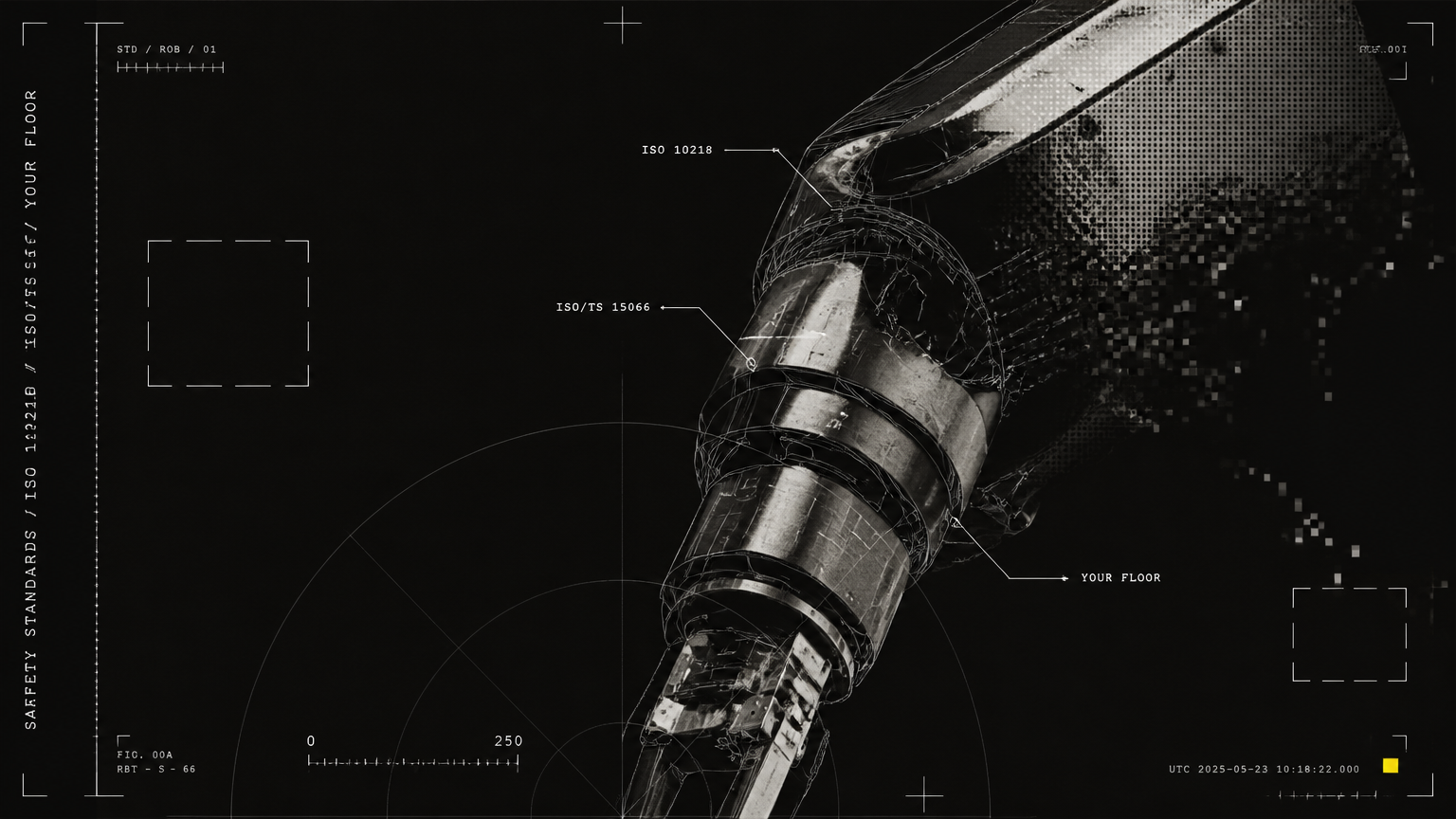
Quick answer: ISO 10218 sets baseline safety requirements for industrial robots and their integration, while ISO/TS 15066 supplements those rules with practical limits and guidance for collaborative (cobot) human–robot interactions such as power-and-force limits and contact scenarios. To make your floor compliant, perform a focused risk assessment, apply engineering controls (guarding, speed/separation or power‑and‑force limiting), validate with testing and documentation, and embed continuous monitoring, training and maintenance into operations.
robot safety standards matter for every environment where humans and robots coexist — from manufacturing lines and logistics hubs to corporate campuses, hospitals and retail spaces. This guide explains ISO 10218 and ISO/TS 15066, lays out practical, on‑the‑floor steps for compliance, and maps requirements to the industry settings most relevant to Allbotix clients.
How robot safety standards (ISO 10218 vs ISO/TS 15066) differ
At a glance, ISO 10218 and ISO/TS 15066 work together: ISO 10218 establishes the baseline design and integration requirements for industrial robots and robot systems; ISO/TS 15066 adds task‑level guidance for collaborative applications where contact between people and robots is possible or intended.
| Criterion | ISO 10218 | ISO/TS 15066 |
|---|---|---|
| Primary scope | Design, construction and integration of industrial robots and robot systems (manufacturer + integrator obligations). | Technical specification focused on collaborative robot applications and human–robot contact scenarios (supplement to ISO 10218). |
| Applicability | General industrial robot installations (fixed / separated / guarded). | Collaborative robots (cobots) and shared‑workspace tasks where interaction/contact may occur. |
| Risk approach | Systematic risk assessment, protective measures hierarchy, safe integration of control systems. | Task‑specific risk assessment with power‑and‑force‑limits (PFLs), contact duration, and contact geometry guidance. |
| Key outputs | Safety-rated stops, safeguarding, control reliability, emergency stop, protective separation. | Numerical contact force/pressure limits, recommended measurement methods, injury-risk guidance for specific body regions. |
| Validator responsibilities | Manufacturers/integrators must supply documentation, safety manuals, and integrate safeguards. | Integrators/operational teams must run task tests, measure forces, document validations against PFLs. |
| Use with collaborative modes | Describes collaborative operation modes but is general — needs 15066 for PFL validation. | Required for validating collaborative modes such as power & force limiting, speed & separation monitoring. |
What each standard requires — practical notes
- ISO 10218 (for designers/integrators/operators)
- Conduct a system-level risk assessment covering robot, end-effectors, peripherals, and environment.
- Design or verify guards, interlocks, emergency stops, and control reliability (SIL/PL where applicable).
- Provide safety documentation: manuals, wiring diagrams, maintenance procedures.
- ISO/TS 15066 (for collaborative use-cases and validation)
- Identify potential contact scenarios and body regions.
- Measure/estimate forces, pressures and contact durations; compare to published limits.
- Validate the selected protective strategy (PFL, reduced speed, or separation) via tests and records.
Applying robot safety standards on your floor: Practical step‑by‑step
Below is an operational roadmap that translates standards into repeatable on‑floor actions.
1. Focused risk assessment
- Scope: Define tasks, people traffic patterns, maintenance access, and worst‑case failure modes.
- Identify hazards: collisions, crushing, entrapment, unintended release of energy, falls.
- Estimate exposure: who, how often, and where interaction happens (operators, visitors, cleaning staff).
- Prioritize tasks that will operate in shared spaces (reception robots, AMRs, cobots).
Deliverable: documented risk assessment with risk ratings and decided protection concept.
2. Select controls (engineering-first)
Use the hierarchy of protection: eliminate hazards → guard/separate → control systems → administrative controls/PPE. When comparing common options, use the table below.
| Control Option | Typical use-cases | Strengths | Limitations |
|---|---|---|---|
| Fixed guarding / fencing | Traditional industrial robots, hazardous stations | High reliability, clear separation, legally established | Requires space, can reduce flexibility and workflow efficiency |
| Speed & separation monitoring | AMRs in mixed traffic, robots near walkways | Preserves access, good for dynamic workplaces | Requires reliable sensing, response time validation |
| Power‑and‑Force Limiting (PFL) / cobot mode | Cobots working side‑by‑side with people, service robots | Enables safe contact, flexible interaction | Needs task-level validation, conservative limits for some body regions |
| Interlocks and light curtains | Entry points to hazardous zones | Simple to validate and maintain | Can create nuisance stops if poorly sited |
| Administrative & PPE | Temporary tasks, maintenance access | Low upfront cost | Least effective — should not be primary control |
Select the primary engineering control (or combination) and identify secondary measures (e.g., signage, training).
3. Validate with testing and documentation
- For guarded systems: prove barriers, interlocks, and stop times meet safety requirements.
- For collaborative systems (ISO/TS 15066): perform contact tests, measure forces/pressures, and document that task forces are within the published PFLs for affected body regions.
- For AMRs: validate braking, path planning, obstacle detection, and speed reduction logic under realistic traffic and floor conditions.
- Maintain a verification file: test procedures, raw measurements, calibration reports, and acceptance certificates.
Deliverable: Verification file and updated safety manual attached to the robot/installation asset.
4. Embed continuous monitoring, training and maintenance
- Operational monitoring: Use fleet-management software to log events, near-misses, stop causes and uptime metrics.
- Predictive maintenance: Monitor motor currents, battery health, and sensor status to reduce degraded‑performance hazards.
- Training: Role-based operator and maintenance training, with renewal cadence and documented competency checks.
- Periodic reviews: Re-run risk assessment after layout changes, new tasks, or software updates.
Allbotix advantage: our in‑house AI fleet‑management and predictive‑maintenance layer (used across 525+ robots and 180+ clients) provides real‑time telemetry, automated alerts and historical logs that make continuous compliance practical. With a documented 99.8% uptime and 24/7 Premium Support, Allbotix helps operators translate validation into long‑term safety performance.
Controls comparison: Which fits your use-case?
| Use-case / Criterion | Fixed guarding | Speed/separation (AMRs) | PFL / Collaborative mode |
|---|---|---|---|
| Best for high-risk, repetitive industrial processes | ✓✓✓ | ✓ | |
| Best for dynamic human traffic (offices, retail, airports) | ✓✓✓ | ✓ | |
| Preserves human access and flexibility | ✓✓ | ✓✓ | |
| Requires task-level biomechanical testing | ✓✓✓ | ||
| Implementation complexity | Low–Medium | Medium–High | High |
| Ongoing monitoring needs | Medium | High (sensing reliability) | High (force sensors, logs) |
Industry‑specific mapping: checklist and common pitfalls
Below are tailored checklist items and pitfalls to watch for across common Allbotix verticals.
Corporate campuses, co‑working, office parks
- Checklist: speed‑limited AMR routing during peak foot traffic; virtual geofencing for events; clear signage; visitor training for reception robots.
- Pitfalls: assuming low traffic equals low risk; neglecting contractors/cleaning staff in assessments.
Healthcare (hospitals, clinics)
- Checklist: infection control-compatible surfaces, validated contact force for nurse‑assist cobots, secure data handling in fleet software, operating-room exclusion zones.
- Pitfalls: prioritizing efficiency over PFL validation; inadequate cleaning/sterilization procedures damaging sensors.
Retail, malls, hospitality
- Checklist: crowd-aware AMR modes, deployable temporary barricades for demonstrations, tested emergency stop behavior in public spaces.
- Pitfalls: poor AMR path planning in peak hours; failing to test behavior with children or distracted customers.
Education, public services, airports & transit hubs
- Checklist: robust signage, low-speed modes, accessibility-compliant paths, staff handover procedures.
- Pitfalls: underestimating unpredictable behavior in large crowds; skipped refresher training for seasonal staff.
Manufacturing & logistics
- Checklist: segregated robot cells for heavy robotics; collaborative workstations validated to ISO/TS 15066; integration of safety PLCs and watchdog functions.
- Pitfalls: retrofitting cobots into legacy cells without system-level risk reassessment.
General operational tips
- Treat software updates as safety changes: any F/W or fleet-management change that affects motion, sensing or HMI should trigger a reassessment.
- Include non-routine tasks (maintenance, cleaning) explicitly in the risk assessment.
- Record near-misses and use them to iterate controls and SOPs.
Sustaining safety with software and fleet management
Software is central to maintaining compliance day-to-day:
- Real‑time monitoring: automated alerts for sensor degradation, obstacle-detection errors, or deviations from safe profiles.
- Version control & change logs: every firmware or path-planning change logged and linked to the verification file.
- Predictive maintenance: reduces the chance that a failing motor or sensor creates an unsafe behavior window.
- Usage analytics: identify hotspots (zones with frequent stops or near-misses) and feed those into layout and policy decisions.
Allbotix builds fleet‑management and predictive maintenance in-house — not a third‑party bolt-on. That allows precise pairing of hardware behavior to safety policies and rapid root-cause diagnostics when anomalies occur.
Common validation checklist (ready-to-use)
- Completed and signed risk assessment for the specific task/area.
- Safety concept documented (guarding, PFL, speed limits).
- Test procedures and raw data for force/pressure/contact-duration (where applicable).
- Safety manual and maintenance schedule attached to the asset.
- Operator & maintenance training records stored.
- Fleet-management monitoring enabled and baseline metrics established.
- Scheduled re-assessment dates and triggers (layout change, SW update, incident).
Closing: making standards real on your floor
robot safety standards (ISO 10218 and ISO/TS 15066) provide a clear, complementary framework: design and integration requirements plus task‑level validation for collaborative interactions. Translating those standards into a safe, productive floor requires disciplined risk assessment, selection of engineering controls, rigorous validation and a software‑enabled maintenance and monitoring program.
Allbotix brings practical experience across 525+ robots and 180+ clients, combining precision engineering, in‑house firmware and a proprietary AI fleet‑management stack to help multi‑vertical operators meet and sustain compliance. Backed by publicly listed Nanta Tech Limited, with Made‑in‑India manufacturing and 24/7 Premium Support, Allbotix can help you choose the right protective strategy for your environment and operational goals.
Ready to map ISO 10218 and ISO/TS 15066 onto your floor plan? Contact Allbotix for a safety-first site assessment and deployment plan tailored to your industry and traffic patterns.
Explore this guide in depth
Each of these guides answers one question from this overview in full: